

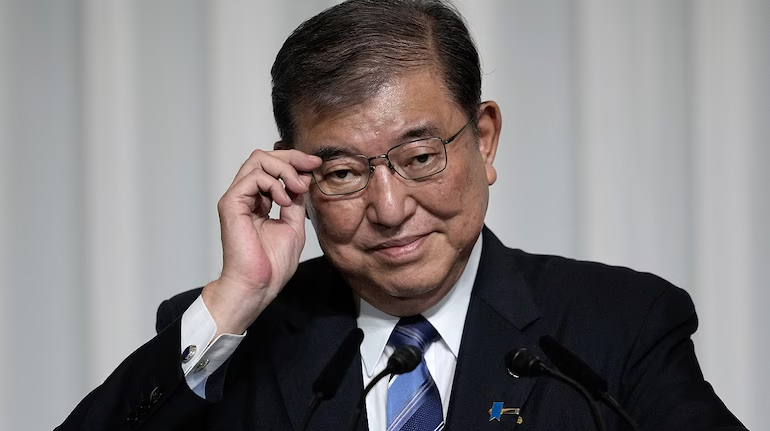

TOKYO — Japanese Prime Minister Shigeru Ishiba announced his resignation on Sunday, a move that plunges the nation’s politics into a period of uncertainty. Ishiba’s decision to step down comes after his Liberal Democratic Party (LDP) and its coalition partner suffered a series of major electoral defeats, losing their majority in both houses of parliament for the first time in nearly seven decades.
Ishiba, who took office in October 2024, had been under pressure from within his own party for over a month to resign. His departure was a strategic move to prevent a party split, as a key LDP committee was scheduled to vote on whether to hold an early leadership election—a de facto no-confidence motion against his leadership. Ishiba cited the recent conclusion of tense tariff negotiations with the United States as a key milestone that allowed him to “pass the baton to the next leader,” according to a press conference he held. The two nations had recently signed a memorandum of understanding, leading to a U.S. executive order outlining Japanese investments in exchange for lowered tariffs.
The LDP’s loss of a parliamentary majority means that its new president is no longer guaranteed to become prime minister. The political climate is now more unpredictable than at any time in recent history, as an opposition party leader could potentially take the helm of the world’s fourth-largest economy.
The Path to a New Prime Minister
The process for selecting Japan’s new leader will involve two stages: a party leadership race and a vote in the parliament.
1. Party Leadership Race (LDP): The LDP must first elect a new president. Candidates are required to secure at least 20 nominations from LDP lawmakers to be eligible to run. The process involves debates and campaigns across Japan, culminating in a vote by both lawmakers and rank-and-file party members. In the last election, nine contenders vied for the position, with Ishiba winning in a run-off. The final vote is decided by a simple majority, with a run-off between the top two candidates if no one secures more than 50% of the vote.
2. Parliamentary Vote: With the LDP holding a minority government, the new party president is not guaranteed the prime ministership. The more powerful lower house of the Diet will hold a vote to select the next prime minister. Any candidate who receives a simple majority in the first round wins. If there is no clear winner, a run-off between the top two candidates will be held. A similar process will follow in the upper house. If the two chambers disagree on the choice, the decision of the lower house will prevail. The newly appointed prime minister may then call a snap general election to seek a national mandate.
Potential Contenders
Several prominent politicians from both the ruling LDP and the opposition are expected to throw their hats into the ring.
LDP Candidates:
- Sanae Takaichi (64): A veteran politician and a prominent conservative, Takaichi is seen as a strong contender. She lost to Ishiba in the last leadership race and is known for her hawkish views on security and her opposition to the Bank of Japan’s interest rate hikes. If elected, she would become Japan’s first female prime minister.
- Shinjiro Koizumi (44): The son of former Prime Minister Junichiro Koizumi, he would be the youngest prime minister in the modern era. Koizumi is a proponent of reform and has a reputation for being an outsider. He has held cabinet positions, including Minister of Agriculture, but his views on economic policy are not widely known.
- Yoshimasa Hayashi (64): Currently the Chief Cabinet Secretary, Hayashi has extensive experience, having served in multiple cabinet posts, including defense and foreign minister. A fluent English speaker with a background in business and education from the U.S., he has consistently advocated for the independence of the Bank of Japan.
Opposition Candidates:
- Yoshihiko Noda (68): The former Prime Minister and leader of the largest opposition party, the Constitutional Democratic Party of Japan (CDPJ), Noda is a key figure who could contend for the top job. Known for his fiscal conservatism during his previous term, he has recently shifted his stance, calling for a temporary cut to the consumption tax on food items.
This period of political instability comes as Japan grapples with a range of domestic challenges, including a stagnating economy, and faces a new landscape in its international relations.