

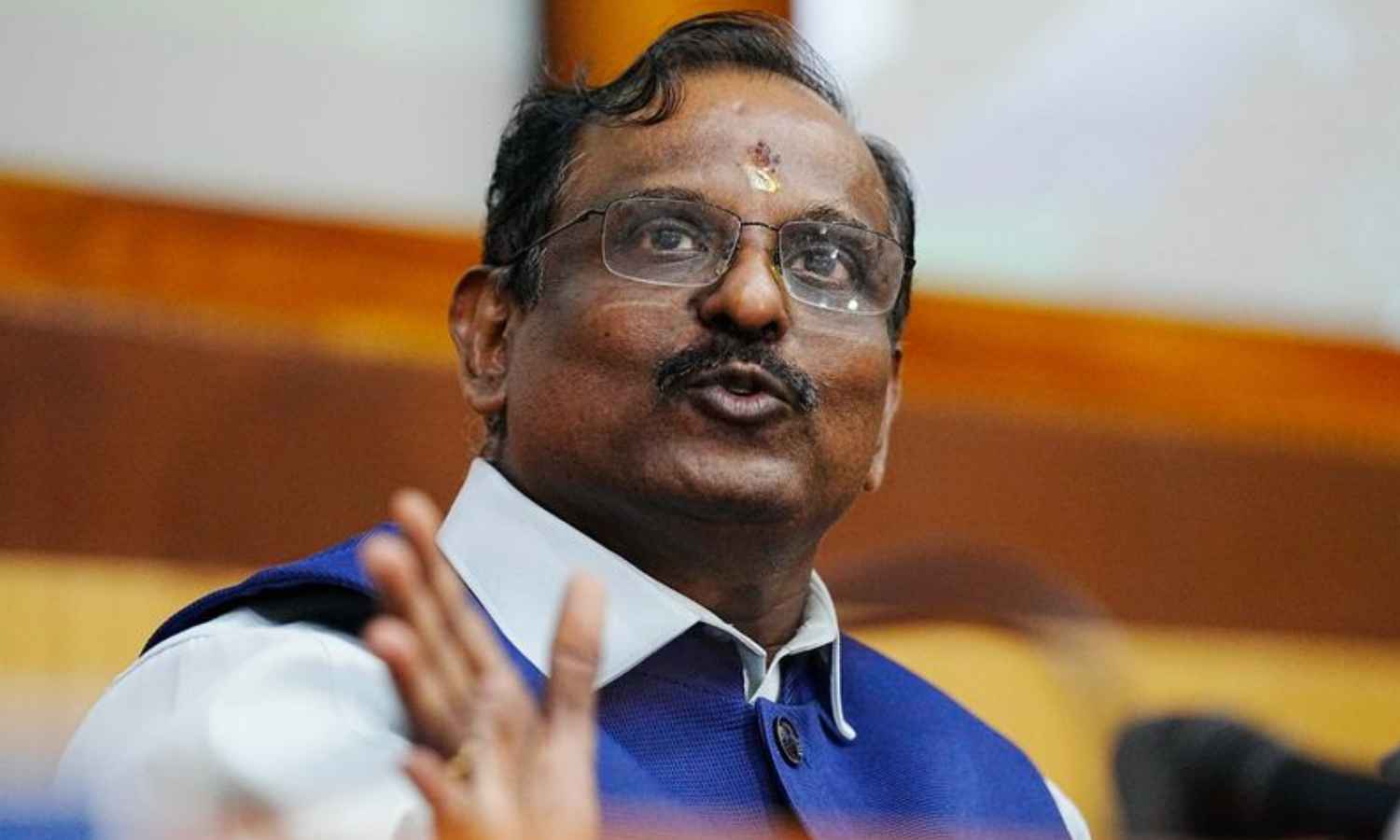

Ranchi: India has set one of its most ambitious space objectives yet: to send its own people to the Moon by 2040. Indian Space Research Organisation (ISRO) Chairman V Narayanan told the media on Wednesday that the agency is also on track to launch its first human spaceflight mission, Gaganyaan, by 2027. This will be a huge step forward for India’s space program.
Narayanan said that ISRO is following a detailed plan for India’s next-generation space missions, which includes creating an Indian space station by 2035 and sending missions to Venus and Mars to explore deep space. This is all thanks to the vision and direction of Prime Minister Narendra Modi.
Narayanan added, “Prime Minister Narendra Modi has set a goal for an indigenous crewed lunar mission by 2040, which means we have to land our own people on the Moon and bring them back safely.” He also said that a Venus Orbiter Mission (VOM) has been approved to investigate the planet.
India’s Next Big Steps in Space
The head of ISRO noted that development on the Bharatiya Antriksh Station (BAS), India’s proposed space station, is moving forward. The first modules should be launched by 2027, and the station should be fully operational by 2035.
The Gaganyaan mission by ISRO, which is India’s first human spaceflight program, is also moving quickly.
“Things are changing a lot in Gaganyaan. Narayanan added, “We are planning three uncrewed missions before the crewed mission.”
The first uncrewed flight, which will carry “Vyommitra,” a female half-human robot made to mimic human body circumstances, is set for December 2025. In 2026, there will be two further uncrewed trips, which will set the stage for the crewed Gaganyaan mission in early 2027.
While hosting the 35th convocation of Birla Institute of Technology (BIT) Mesra in Ranchi, Narayanan made the announcement as the principal guest.
Big Missions Coming Up
India’s space achievements are getting a lot of attention throughout the world, and ISRO is preparing a number of important missions, such as Chandrayaan-4, Chandrayaan-5, a new Mars mission, and AXOM, an upgraded astronomical observatory project.
He pointed out that Aditya-L1, India’s first solar mission, has already sent back more than 15 terabits of solar data, which has helped us learn more about coronal mass ejections and space weather.
Narayanan added, “We are open to working with other countries.” He went on to say that India values self-reliance, but that cooperation in climate science and planetary research will continue “based on scientific and strategic priorities.”
Changes in the private sector and space
Narayanan said that the Indian National Space Promotion and Authorisation Centre (IN-SPACe) and the government’s changes to the space sector helped bring startups and private firms into the space ecosystem.
“Not too long ago, there were only one or two startups in the space industry. He said, “Today, more than 300 people are working on making satellites, launching them, and analyzing data from space.”
He said that this quick expansion is important for satisfying India’s growing need for satellite-based services in areas like agriculture, disaster management, telecommunications, real-time monitoring, and fishing.
Building the Future: More Powerful Launches
India is making big improvements to its launch infrastructure to handle crewed flights to the moon and logistics for the space station.
Narayanan stated, “We want to see a change of this scale: from launching 35 kg to now imagining 80,000 kg.” He also claimed that ISRO just got permission to build a third launch pad at Sriharikota, which will cost about ₹4,000 crore.
The new pad will be able to handle all types of launch vehicles, even the next-generation NGLV (Next Generation Launch Vehicle).
The New Space Age: AI, Robotics, and
Narayanan said that AI, robotics, and big data are going to change the space industry in a big way.
He said, “Just like no one thought about the computer revolution 35 years ago, AI and robots will shape the next era of space exploration.”
He said that India is now the world’s fourth-largest economy and one of the most active space nations. For example, it found water on the Moon (Chandrayaan-1) and made the first soft landing near the lunar south pole (Chandrayaan-3).
He triumphantly said, “India is now number one in nine areas of global space research.”
Successes in atomic energy and more
The head of ISRO also talked about India’s accomplishments in nuclear energy, saying that the country now has 23 nuclear reactors running in eight plants, including big ones at Tarapur and the Bhabha Atomic Research Centre (BARC).
Narayanan became the chairman of ISRO in January 2025. Before that, he was the director of ISRO’s Liquid Propulsion Systems Center (LPSC), which is important for India’s biggest launch missions.