

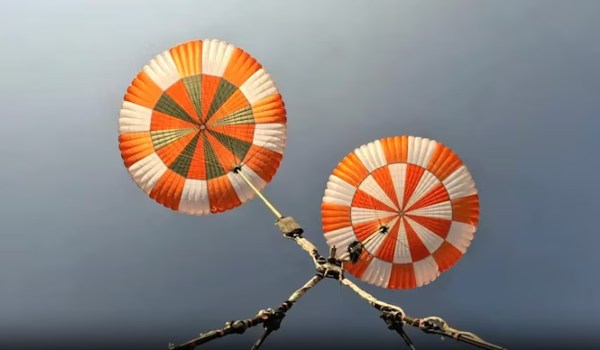

The Indian Space Research Organisation (ISRO) achieved a major milestone in its quest for human spaceflight on Saturday, December 20, 2025. The space agency successfully concluded a rigorous series of qualification tests for drogue parachutes, a vital component of the deceleration system designed to bring Indian astronauts safely back to Earth.
The tests were conducted between December 18 and 19 at the Rail Track Rocket Sled (RTRS) facility of the Terminal Ballistic Research Laboratory (TBRL) in Chandigarh.
The “Gaganyaan” Deceleration Sequence
The recovery of the Gaganyaan Crew Module is a high-stakes, multi-stage operation involving a total of 10 parachutes of four distinct types. ISRO explained the complex “dance” of parachutes required for a safe splashdown:
- Apex Cover Separation (2 Parachutes): These are the first to deploy, jettisoning the protective cover of the parachute compartment.
- Drogue Parachutes (2 Parachutes): These were the focus of the recent Chandigarh tests. They stabilize the module and drastically reduce its high re-entry velocity to a safer regime.
- Pilot Parachutes (3 Parachutes): Once the drogues are released, these smaller chutes are deployed to “pull out” the final set.
- Main Parachutes (3 Parachutes): These giant canopies ensure the module reaches a terminal velocity slow enough for a soft touchdown.
Note on Redundancy: The system is designed so that even if one main parachute fails, the remaining two are sufficient to ensure a safe landing for the crew.
Test Objectives and Reliability
Union Minister for Science and Technology, Jitendra Singh, lauded the achievement, noting that the tests confirmed the “performance and reliability” of the system under extreme and off-nominal flight conditions.
- Facility: The RTRS facility in Chandigarh uses rocket-propelled sleds on rail tracks to simulate velocities several times the speed of sound.
- Collaborative Effort: The campaign was a massive inter-agency effort involving the Vikram Sarabhai Space Centre (VSSC), the Aerial Delivery Research and Development Establishment (ADRDE), and DRDO.
What’s Next for Gaganyaan?
The successful qualification of the drogue system brings India one step closer to its first uncrewed Gaganyaan flight, currently targeted for early 2026, followed by the historic crewed mission.
In a related development, ISRO is also preparing for a collaborative mission with the U.S. (NASA), with a satellite launch scheduled for December 24, 2025.