

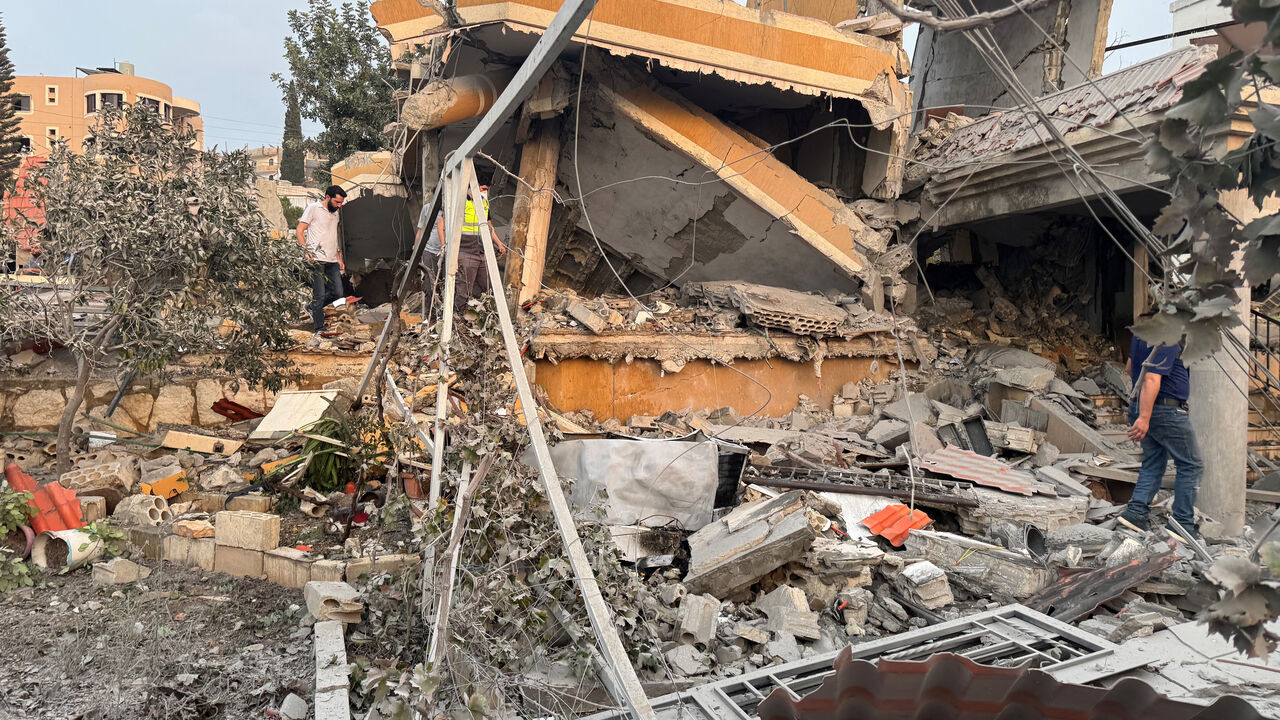

Beirut: The Israeli military launched a series of heavy airstrikes on southern Lebanon on Thursday, shortly after issuing evacuation orders for multiple areas, claiming that Hezbollah was attempting to rebuild its military infrastructure in the region.
The strikes came despite a ceasefire agreement signed a year ago that was meant to end more than twelve months of hostilities between Israel and the Iran-backed Hezbollah, and after ongoing efforts by the Lebanese army to clear Hezbollah sites in southern Lebanon.
According to the Lebanese Health Ministry, one person was killed and another injured in the latest wave of bombings. The attacks began roughly an hour after evacuation orders were issued, with thick plumes of smoke reported rising from several villages.
At around 3 p.m. local time (1300 GMT), Israeli military spokesperson Avichay Adraee announced evacuation orders via X (formerly Twitter), targeting specific areas in the villages of Aita al-Jabal, Al-Tayyiba, and Tayr Debba. Two additional orders followed later in the evening for other southern towns.
The identified locations range between 4 km and 24 km from the Israeli border, and residents were instructed to maintain a 500-metre distance from the marked zones. Lebanon’s civil defence teams assisted in evacuations, the state-run National News Agency reported.
Local authorities expressed deep concern over the escalating situation. “We are in a very dangerous situation. If things keep heading this way, all hope is lost,” said Farid Nahnouh, mayor of Tayr Debba. “No one knows where the consequences of these matters will lead.”
While Israel has routinely targeted sites it claims are linked to Hezbollah over the past year, the latest operations stood out for their combination of airstrikes and formal evacuation orders — a move seen as an indication of increased military intensity.
Israeli government spokesperson Shosh Bedrosian said on Thursday that Israel would “continue to defend all its borders” and insisted on the full enforcement of the ceasefire agreement. “We will not allow Hezbollah to rearm or regain the military capabilities that were destroyed during the 2023–24 conflict,” Bedrosian stated.
Hezbollah, meanwhile, reaffirmed its commitment to the ceasefire, asserting its “legitimate right” to resist Israeli aggression but clarifying that it had not fired on Israel since the truce took effect. The group also noted that it had not interfered with the Lebanese army’s disarmament operations in the south.
The evacuation orders coincided with a cabinet meeting in Beirut, where army commander Rodolphe Haykal briefed ministers on progress in dismantling Hezbollah weapons depots. Lebanese officials told Reuters earlier in the day that the army was making steady progress and expected to clear all of southern Lebanon of non-state weapons by year-end.
Among the sites hit in Thursday’s attacks was an ironworks shop in the town of Abbasiyeh, which was completely destroyed. “This shop supported five to six households,” said owner Ahmad al-Kayyal. “We made chairs, tables, windows, railings — basic things for people’s homes. Now it’s all gone.”
The latest strikes have reignited fears that Israel could resume a full-scale aerial bombing campaign, potentially destabilizing the fragile ceasefire that has held, though uneasily, since 2024.