

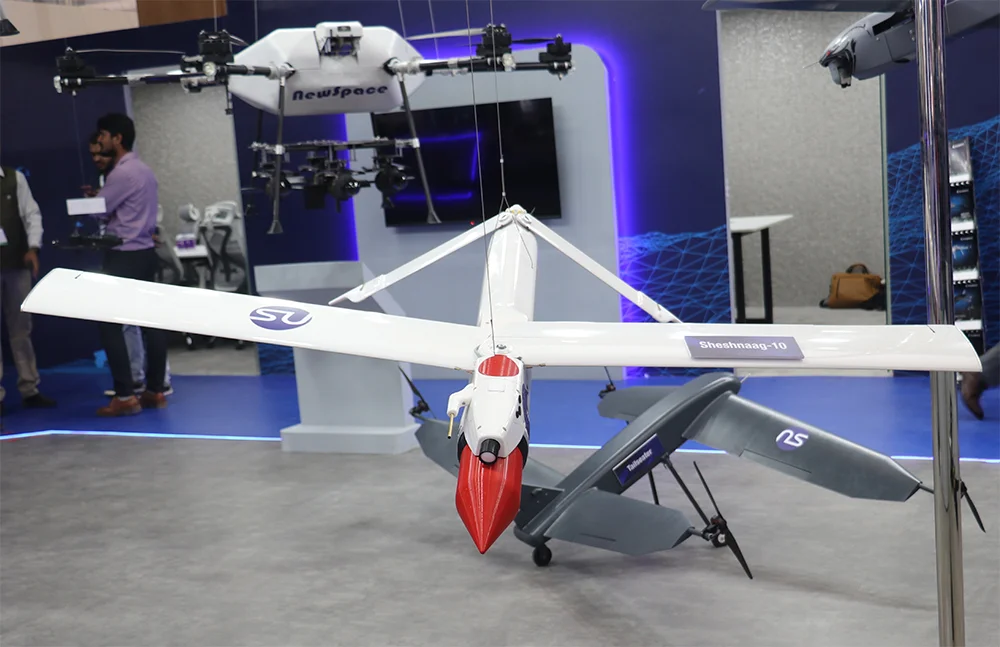

New Delhi: As low-cost suicide drones reshape battlefields from Eastern Europe to West Asia, India’s own response to this evolving form of warfare — the Sheshnaag-150 — is steadily advancing through development and testing.
Built from the ground up by Bengaluru-based defence startup Newspace Research Technologies (NRT), the long-range swarming attack drone first flew a year ago. However, the urgency surrounding its development has intensified significantly following Operation Sindoor, when NRT was tasked with deploying other drone capabilities for the Indian military at the frontline.
What was once an ambitious in-house innovation programme is now being viewed as an operational necessity.
The Global Context: Cheap Drones, Big Impact
The renewed push for systems like Sheshnaag comes amid dramatic lessons from global conflicts.
Iran’s Shahed-136 has repeatedly demonstrated how low-cost, expendable drones can overwhelm sophisticated air defence systems through sheer volume and persistence. Designed as a loitering munition, the Shahed-136 has inflicted disproportionate damage relative to its cost, saturating enemy defences and striking high-value targets.
The United States responded with its own derivative platform, the LUCAS drone, inspired by the Shahed template. Integrated with advanced communications networks such as Starlink, LUCAS underscored a critical military lesson: in modern warfare, autonomous, networked and numerous platforms can outmatch expensive, singular systems.
For India, the message has been clear — the future of battlefield dominance lies in swarms, autonomy and algorithmic intelligence.
What Is the Sheshnaag-150?
The Sheshnaag-150 is designed as a coordinated swarming strike drone capable of executing long-range attack missions with minimal human intervention.
Key reported capabilities include:
- Operational range exceeding 1,000 km
- Endurance of over five hours
- Swarm-enabled coordinated attack profiles
- Warhead capacity of 25–40 kg
- Autonomous target identification and engagement
- Real-time surveillance and loitering capability
The system is intended to overwhelm adversary air defences through saturation tactics while simultaneously carrying out precision strikes on infrastructure, vehicles and strategic positions.
However, defence analysts suggest that the most significant component of the Sheshnaag system is not the airframe itself — but the software that powers it.
The “Mother-Code” Advantage
While building small unmanned aerial vehicles is increasingly accessible, developing the algorithmic backbone that allows drones to operate as intelligent swarms is far more complex.
The Sheshnaag programme’s core strength lies in its proprietary control architecture — described as the “mother-code” — which enables:
- Autonomous coordination between multiple drones
- Dynamic target allocation
- Self-refreshing swarm behaviour
- Resilience against jamming and cyber disruption
- Efficient, real-time attack path optimisation
Unlike earlier systems reliant on satellite navigation, the Sheshnaag-150 is expected to incorporate visual navigation systems capable of operating in GPS-denied environments — a critical advantage in high-intensity electronic warfare scenarios.
In this regard, India aims to move beyond both the Shahed-136 and even the LUCAS in terms of autonomy and operational survivability.
Lessons from Operation Sindoor
During Operation Sindoor, Pakistan reportedly deployed hundreds of low-cost drones not only for attack missions but also to saturate Indian air defences, force resource expenditure and expose ground positions by compelling defensive fire.
While most of these drones were neutralised before completing their objectives, the tactic signalled a doctrinal shift toward attrition-based drone warfare.
India, by contrast, employed a smaller number of specialised attack drones and loitering munitions. These reportedly succeeded in targeting radar installations and air defence units, weakening Pakistan’s air posture and enabling follow-on air operations.
The episode appears to have accelerated India’s internal reassessment of drone doctrine — shifting focus from defensive interception toward offensive swarm dominance.
The Drone Age at India’s Doorstep
Recent conflicts — including Operation Epic Fury, Operation Sindoor and the prolonged war in Ukraine — have underscored one undeniable truth: low-cost, expendable and autonomous systems are redefining military strategy.
For India, the Sheshnaag-150 represents more than a single weapons platform. It reflects a broader transformation in defence thinking — from reliance on expensive, high-value platforms to distributed, intelligent and networked strike capabilities.
If development progresses as intended, Sheshnaag-class systems could become a cornerstone of India’s emerging drone warfare doctrine, offering scalable, cost-effective deterrence against both conventional and asymmetric threats.
As global battlefields continue to evolve, India’s answer may not lie in building bigger systems — but smarter swarms.