

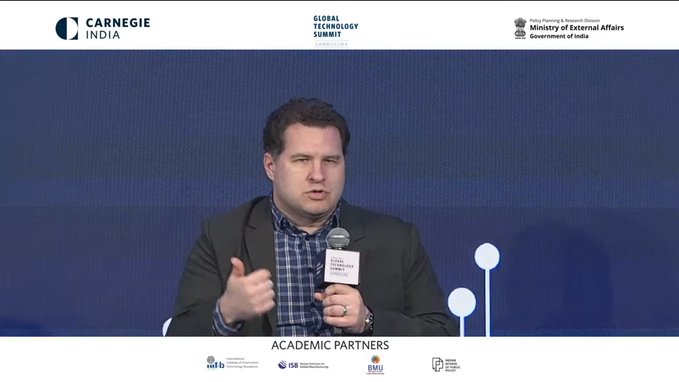

New Delhi [India]: India is steadily establishing itself as a major force in the global semiconductor industry, evolving from its established position in chip design to actively exploring semiconductor manufacturing. This shift was highlighted by John Neuffer, President and CEO of the Semiconductor Industry Association, during his address at the 9th Carnegie Global Tech Summit in New Delhi.
Neuffer praised India’s progress in the sector, stating, “India has done a lot right when it comes to our sector. 20 per cent of our workforce is here. We have a core design of our ships. We have a great ecosystem for that. I think we are in a very special moment right now. We have this trust initiative in front of us. We also have a bilateral trade agreement in front of us.”
He pointed to India’s significant strides toward manufacturing, noting that “Two years ago, there was really nothing in play. Now there are six important projects in play for manufacturing including the assembly test packaging facility being built.” Neuffer believes initiatives like the trust initiative and bilateral trade agreements could drive major change, positioning India as not just a design hub but a manufacturing destination.
Also speaking at the event, Siddharth Mittal, CEO and Managing Director of Biocon Limited, discussed India’s role in the pharmaceutical supply chain, especially with regard to the US market.
“The US has a great research ecosystem. We have the talent, and India has a good understanding of the entire ecosystem. The US, of course, has a great research ecosystem, and I think that’s where I see a first opportunity. How do you join hands to innovate or create joint innovation hubs to do the same thing in a different way?” said Mittal.
He also addressed concerns over dependency on China for raw materials in the pharmaceutical sector, adding, “When we talk pharmaceuticals, it’s because of over-dependency and reliance on China… India is still dependent 70 per cent on China to procure starting materials or raw materials. So, if we do not address the entire value chain, we will not fix the problem.”
Highlighting India’s contribution to the US market, he said, “Forty-fifty per cent volumes of the drug consumed by patients in the US comes from India. And I think that already speaks a lot about the partnership that we had over the past four decades informally.”
Rob Sherman, Vice President, Policy & Deputy Chief Privacy Officer at Meta, emphasized the importance of localized AI development. “If you are making an AI model, and you want to serve a country like India, it needs to understand the Indian data set, Indian language, Indian concepts, so a part of that is creating data sets that can be used, and the Government of India has done heavy work in that.”
Sushil Pal, Joint Secretary at the Ministry of Electronics and Information Technology, Government of India, highlighted the strategic significance of the India-US Initiative on Critical and Emerging Technology (iCET).
“I think iCET has been one of the most productive bilateral cooperation with the US. India’s first semiconductor plant was with the cooperation from American industry and the production from the pilot facilities have already started. Hopefully, by the end of the year, I think from the main facility as well, it should be starting,” Pal said.
He added, “Apart from that, not only in the fabrication and packaging space but also in the design space, there has been a massive collaboration and interest being shown by many companies of US origin… It covers the complete spectrum of the semiconductor value chain, the design, fabrication to the terrain building, R&D and all that.”