

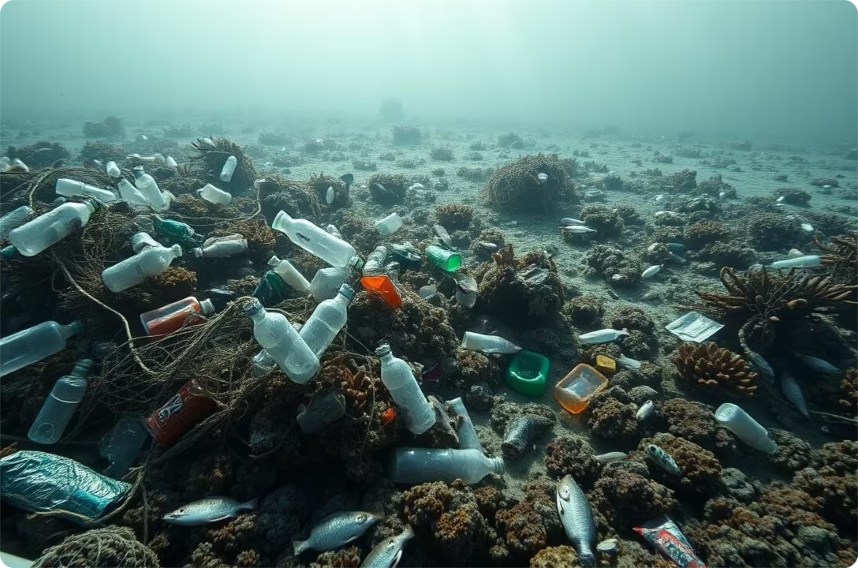

Ahead of the United Nations Ocean Conference (UNOC), scheduled from June 9 to 13 in Nice, France, Indian ocean experts have raised concerns about the growing plastic pollution threatening marine life along the country’s coastline.
A global survey involving 58 ocean experts from 19 countries identified plastic in the oceans as one of the biggest threats to marine ecosystems in India.
UNOC is being described by French officials as the most ambitious environmental gathering since the 2015 Paris Climate Conference that produced the landmark Paris Agreement.
“Ten years after COP21 and the Paris Agreement, UNOC-3 represents a historic opportunity to establish a binding global framework, and the Nice Agreement will constitute a real international pact for the conservation and sustainable use of the ocean,” officials said during a recent briefing.
Indian Experts Voice Concerns
“It is alarming that around 5% of marine catch from coastal waters contains plastic waste,” said Sunil Mohamed, Chair of the Sustainable Seafood Network of India and former principal scientist at the ICAR-Central Marine Fisheries Research Institute (CMFRI), who was among three Indian participants in the survey.
He urged for “strict measures to tackle the menace through coordinated and joint efforts of public and government agencies,” emphasizing, “There is inherent resilience in ocean ecosystems, and hence good fisheries management and environmental care could greatly help to restore the ecosystems.”
S Sabu, Associate Professor at Cochin University of Science and Technology, another Indian expert in the survey, highlighted the cascading effects of poor waste management.
“The main problem is whatever ends up in our rivers and lakes or even in streams in the hilly regions will eventually come to the sea if the waste is not properly collected and disposed of. Aquatic life including fish mainly consume phytoplankton and other plankton. The degraded plastic is mistaken to be plankton and consumed by aquatic life which finally also ends up in the bodies of consumers who are consuming fish and other seafood,” he said.
“This also applies to use of pesticides, industrial waste, fertilizers on land which will end up downstream. These carry pollutants and carcinogenic compounds. I highlighted these issues to the MSC,” he added. The MSC is an international non-profit organization that collaborates with over 700 fisheries worldwide.
Broader Environmental Challenges
The survey found that most scientists believe climate change is the biggest threat to ocean health, citing ocean warming, sea level rise, and changes in currents and weather patterns. Marine pollution, overfishing, and habitat loss were also ranked as serious concerns.
“Scientists from every single inhabited continent agree ocean biodiversity is under threat but there is still reason for optimism if we act now to save it for the future,” MSC stated.
UNOC 2025: Priorities and India’s Role
The third edition of UNOC is being co-hosted by France and Costa Rica. It has three key priorities:
- Support multilateral governance processes, especially the ratification and implementation of the Biodiversity Beyond National Jurisdiction (BBNJ) treaty.
“The high seas treaty cannot be a failure. If we do not seize the opportunity of UNOC-3, we risk wasting precious years for the sustainable management of the ocean,” a French official said. India signed the BBNJ Treaty last year but has yet to ratify it.
“India is proud to join the BBNJ Agreement, an important step towards ensuring that our oceans remain healthy and resilient,” External Affairs Minister S Jaishankar had posted on X after signing the treaty in New York in September. - Mobilize public and private funding to achieve SDG 14, which seeks to “conserve and sustainably use the oceans, seas and marine resources for sustainable development” and to foster a sustainable blue economy.
- Improve dissemination of oceanographic knowledge to inform public policy through open access to global ocean data.
As the world prepares for UNOC 2025, India’s ocean experts are calling for urgent action to address plastic pollution, enforce sustainable practices, and restore marine ecosystems—before it’s too late.