

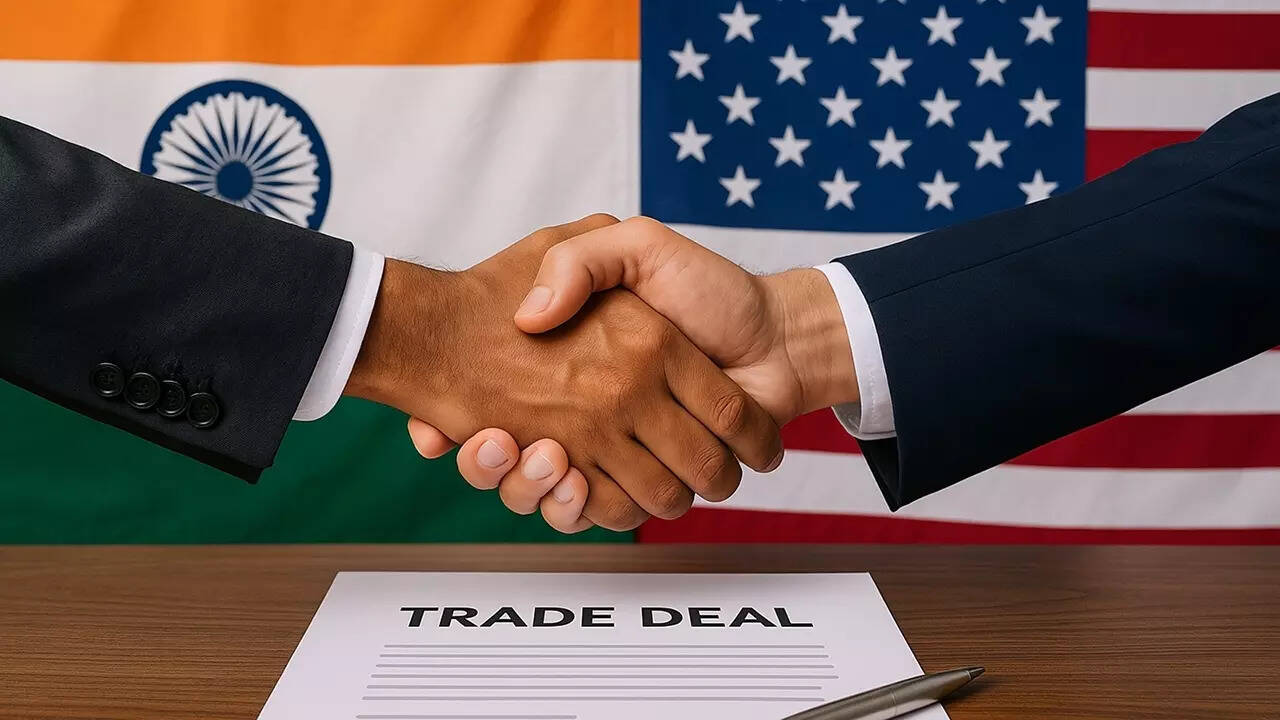

Even though US President Donald Trump just announced harsh tariffs on Indian exports, it is said that both India and the US are “intensely engaged” in talks to reach a “mutually beneficial early trade deal” by the end of August. People who are close to the talks say that these actions are only happening inside the framework that was agreed upon by both sides on March 29. They are moving forward despite the political hyperbole that is still going on.
Trump’s Position on Tariffs and India’s Limits
Donald Trump said on Truth Social on July 30 that there will be a 25% tax on Indian goods coming into the United States. He also said that India would have to pay an unknown amount for buying Russian oil. This change, which went into effect on August 1, is seen to be a direct result of India’s refusal to compromise on protecting its important agriculture, dairy, and Micro, Small, and Medium Enterprises (MSME) sectors against unrestricted American imports.
Another big reason why Trump reacted so strongly is that India depends on Russian crude oil a lot. India is the world’s third-largest importer of crude oil after the US and China. It gets more than 87% of its processing needs from other countries. The US Energy Information Administration (EIA) revised their research on February 6, 2025, and found that Russia remained India’s main source of crude oil and condensate imports in 2023, making up about 39% of all imports. This was a big jump from 2022, when India started buying cheap Russian oil after the US and EU put sanctions on Russia. This increased India’s imports by more than six times to 740,000 barrels per day.
Trump said on Truth Social on July 31 that he didn’t care what India did with Russia in response to India’s ongoing energy relations with Russia. For all I care, they may take their dead economies down together.
Trade talks are moving forward even though there are problems.
During their first face-to-face meeting in New Delhi on March 29, the two countries agreed on comprehensive Terms of Reference (ToR) for talks about a Bilateral Trade Agreement (BTA). On April 22, US Vice President JD Vance formally announced this during his visit to India, calling it “a vital step toward a final deal.”
Since then, both sides have had five real-life rounds of talks and many more online talks inside this agreed-upon framework. Sources say that a lot of common ground has already been found, enough to make an interim settlement possible.
“We are still communicating virtually as of now, and we will probably work out the last few issues when the American negotiating team comes to India for the sixth round of talks this month,” a source said. The US negotiation delegation is set to arrive in New Delhi on August 24 for the sixth round of talks, which will start on August 25. Even though President Trump has said and done things that make tariffs go up, real results are expected after this round ends successfully by the end of August.
India’s View on Energy Security and Getting Supplies from Different Places
India’s energy security is still the most important thing on its mind. “India’s energy security’s top priority is an affordable and dependable energy supply, and heavily discounted crude from Russia meets both of those needs,” a source said. India gets its energy from many different places, including 39 countries. India has made its position clear: “Our sourcing from Russia would not stop under any external pressure.” This is despite the fact that energy imports from the US have gone up recently and may go up even more if it makes business sense. We are not bound by any one-sided sanction since we follow the UN sanction.
The planned BTA may contain promises to buy more energy from the US, but only if it makes sense for business in the long run. Sources, on the other hand, say again that “the deal cannot and will not limit India’s freedom to find its own energy sources.” We get crude oil from roughly 40 countries, such as the US, the Middle East, and Russia. And the policy of getting supplies from several places will stay the same.