

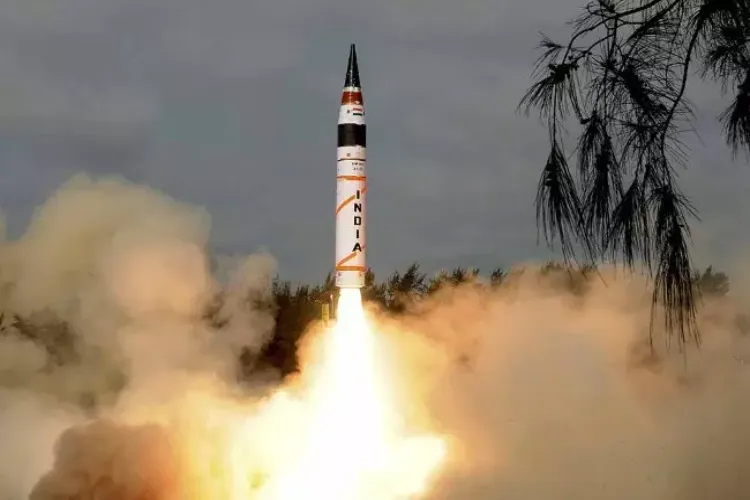

CHANDIPUR, ODISHA — India successfully test-fired the Agni-5 intermediate-range ballistic missile on Wednesday. This was a big step forward for the country’s strategic defense capabilities. The Strategic Forces Command oversaw the test, which took place at the Integrated Test Range in Chandipur, Odisha. It confirmed all of the missile’s important operational and technical criteria.
The Agni-5 can hit targets up to 5,000 km away. It can hit targets all over Asia, including major cities in northern China. It is a key part of India’s nuclear deterrence doctrine because it can carry a nuclear warhead and has a long range. The successful test makes India’s position as a significant strategic force in the area much stronger.
This latest test comes after the Agni-5 was launched in March of last year and comes after recent military tensions with Pakistan. The Agni-5 is one of a group of ballistic missiles that India made itself. All of these missiles are already in use by the Indian military. This includes the Agni-1, Agni-2, Agni-3, and Agni-4, which can travel between 700 and 3,500 kilometers.
India’s missile program encompasses more than only the Agni series. It also has systems like the Prithvi-II and the Pralay. The Prithvi-II is a short-range ballistic missile that can carry nuclear warheads and has a range of 350 km. The Pralay is a tactical surface-to-surface missile that can carry regular warheads. India’s commitment to keeping a strong and credible defense posture is shown by the fact that these missile systems are tested on a regular basis.
The Agni-5 is a solid-fuel rocket with three stages that makes it easier to move and be ready. Its powerful guidance systems make it quite accurate, which makes it a good deterrent.