

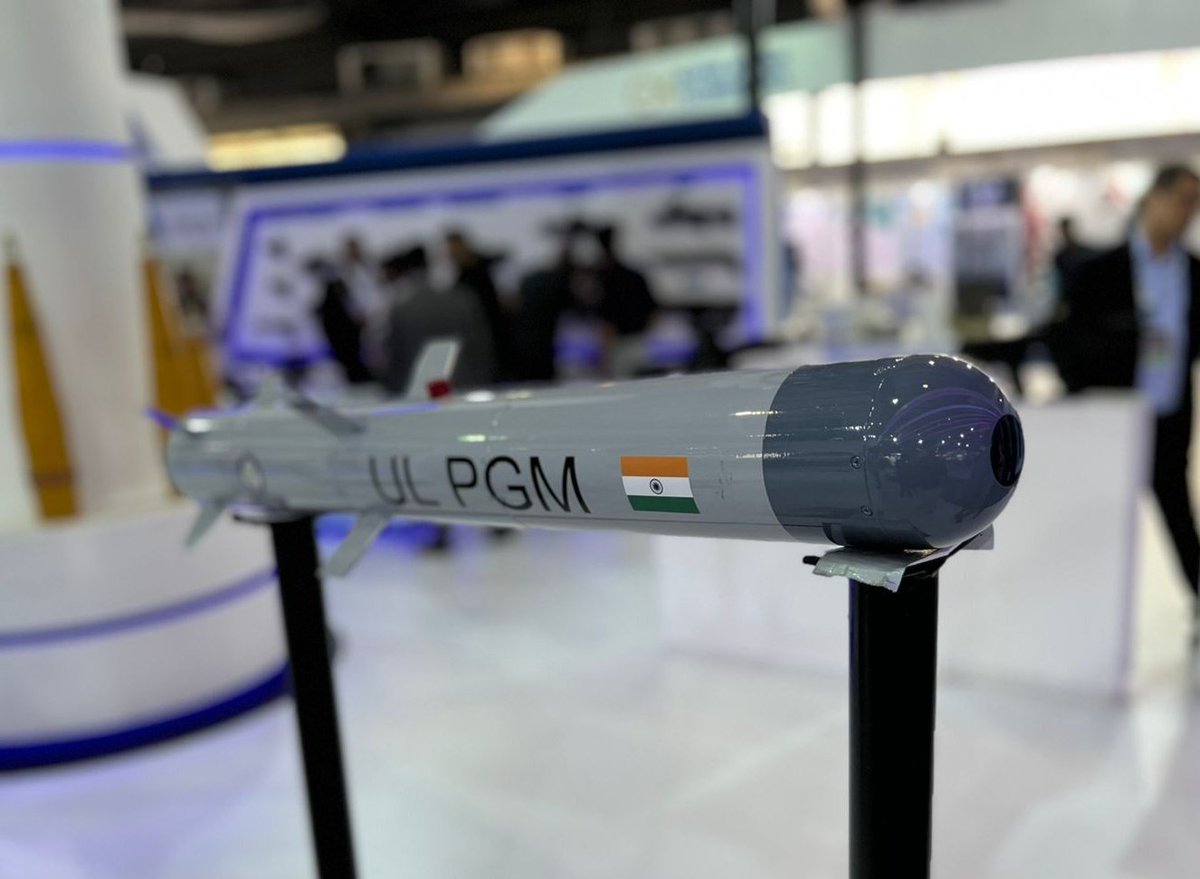

New Delhi, India, July 25— Defence Minister Rajnath Singh said today that India has successfully performed flight tests of the UAV Launched Precision Guided Missile (ULPGM)-V3. This is a big step forward for India’s defense capabilities. The tests were done in the National Open Area Range (NOAR), which is a test range in the Kurnool district of Andhra Pradesh.
The Defence Minister sent his heartfelt congratulations to the Defence Research and Development Organisation (DRDO) and its industrial partners on this amazing accomplishment through social media platform X.
A Big Boost for “Aatmanirbhar Bharat” and Indigenous Defense Technology
The Defence Minister’s tweet on social media said, “In a major boost to India’s defence capabilities, @DRDO_India has successfully carried out flight trials of UAV Launched Precision Guided Missile (ULPGM)-V3 in the National Open Area Range (NOAR), test range in Kurnool, Andhra Pradesh.”
He further said, “Congratulations to DRDO and the industry partners, DcPPs, MSMEs, and Start-ups for making the ULPGM-V3 system and testing it successfully.” This result shows that the Indian sector is now ready to learn and make important defense technologies. This statement shows how important “Aatmanirbhar Bharat” (self-reliant India) is to the government in the defense industry.
This most recent triumph comes after the Indian Army held a lot of Capacity Development Demonstrations in May at important places all around the country. These included the Pokhran Field Firing Ranges, Babina Field Firing Ranges, and Joshimath. There were also planned tests of Air Defense technology at Agra and Gopalpur.
An official press statement from May 31 says that these field experiments took place under settings that were very close to combat. They used electronic warfare simulations to thoroughly test how well new defense systems work. General Upendra Dwivedi, the Chief of the Army Staff, went to the Babina Field Firing Ranges on May 27 to see the demonstrations that were still going on and spoke to everyone involved.
The demonstrations showed off a lot of cutting-edge technology that were made possible by the Aatmanirbhar Bharat program, which is focused on speeding up the development of indigenous capabilities. These tests are an important part of the Indian Army’s plan for a “Decade of Transformation,” which is meant to make sure that new technology are quickly adopted to address changing needs on the battlefield. A lot of partners in the defense sector took part in the displays. This shows how well the Indian Army and domestic manufacturers are working together.
During these long tests, some of the main platforms that were looked at were Unmanned Aerial Systems (UAS), UAV Launched Precision Guided Munition (ULPGM), Runway Independent (RWI) Remotely Piloted Aerial Systems (RPAS), Counter-UAS Solutions, Loitering Munitions, Specialised Vertical Launch (SVL) Drones, Precision Multi Munition Delivery Systems, Integrated Drone Detection and Interdiction System (IDDIS), Low Level Light Weight Radars, VSHORADS (Next Generation) IR Systems, and Electronic Warfare (EW) Platforms.