


In Washington, D.C. — Since Donald Trump became president again in January 2025, India has bought a lot more electricity from the United States. This jump is a direct result of New Delhi’s promise to fix trade relations with Washington, which is something the Trump administration has been asking for.
People who know a lot about trade between the two countries say that India’s imports of crude oil from the US rose by 51% in the first half of 2025 compared to the same time last year. This big rise shows that India’s method for getting energy has changed a lot.
Real Numbers Show Fast Growth
The energy trade has picked up speed a lot:
Imports of Crude Oil: In the first quarter of FY2025–26 (April–June 2025), India’s purchases of crude oil from the US rose 114% to $3.7 billion, up from $1.73 billion in the same time the year before.
LNG Imports: The amount of liquefied natural gas (LNG) that the US sends to other countries has almost doubled, going from $1.41 billion in FY2023-24 to $2.46 billion in FY2024-25.
More crude oil from the US to India: In July 2025, India bought 23% more crude oil from the US than it did in June 2025. This meant that the US’s share of India’s total crude oil imports rose from 3% to 8% in July 2025.
What drives them: strategic agreements and being competitive in the economy
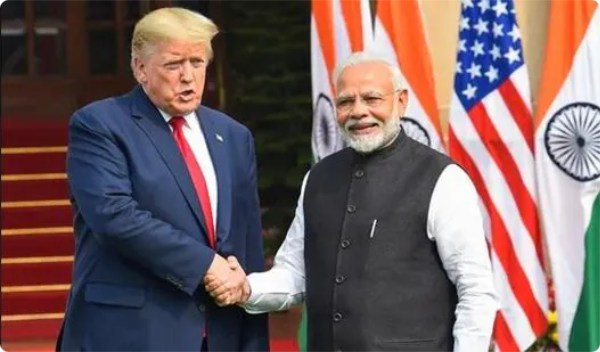
This buying binge for energy comes after a very important deal was made in Washington, D.C. in February 2025 between President Trump and Prime Minister Narendra Modi. Both leaders promised to work together more on energy. India promised to increase its purchases of American energy from $15 billion to $25 billion by 2024. The bigger goal for commerce between the two countries is to more than double, from $200 billion to $500 billion by 2030.
The leaders’ joint statement made clear their shared goal: “The leaders reaffirmed their commitment to increase energy trade, as part of efforts to ensure energy security, and to establish the United States as a leading supplier of crude oil and petroleum products and liquefied natural gas to India.”
Indian corporations are especially interested in American LNG since it is priced competitively. According to Prashant Vashisht, Senior Vice President at the ratings agency ICRA, “US LNG, which is priced based on the Henry Hub benchmark, is very competitive price-wise compared to other sources.” He also said that LNG is becoming more available, with “a large number of LNG projects coming online in the United States, which will mean that more Indian companies will look closely at the American market for tying up long-term contracts.”
The US’s growing exports and India’s growing need
This rise in energy trading comes at the same time as America’s aspirations to quickly boost its oil and gas exports. Shortly after taking office, President Trump lifted the Biden administration’s freeze on processing LNG export licenses. The US Energy Information Administration (EIA) says that by 2028, North America’s LNG export capacity will double. Most of this growth will come from the US.
India’s growing need for energy is very important on the world scene. The International Energy Agency (IEA) says that by 2030, India will be the main driver of global oil demand growth, surpassing China. India’s demand for LNG is also predicted to rise by 78%, reaching 64 billion cubic meters per year.
“People are talking about more long-term LNG contracts worth tens of billions of dollars.” “Indian oil and gas companies are talking to their US counterparts about buying US oil and gas for a long time,” said another source who knows about the situation. This shows how India sees the US as “one of the most reliable partners for India’s energy security.”
Ongoing Disagreement: Buying Russian Oil
Even though India is working more closely with the US on energy issues, it is still buying crude oil from Russia. The Trump administration has always told New Delhi to rethink its energy ties with Moscow in order to get President Vladimir Putin to agree to halt the war between Russia and Ukraine. India’s diverse energy import strategy is still shaped by this delicate balancing act in world politics.