

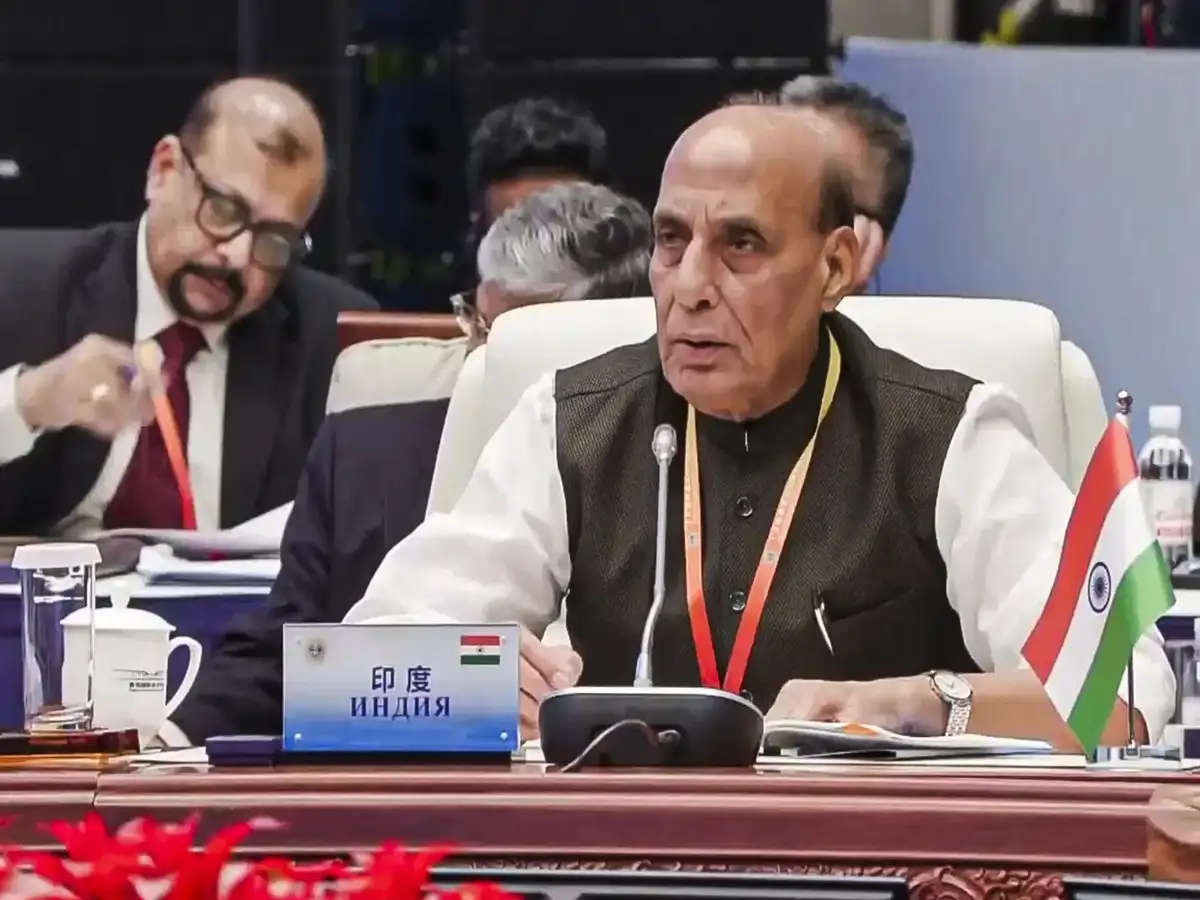

New Delhi – During a high-level defence dialogue in Qingdao, China, Defence Minister Rajnath Singh on Thursday urged his Chinese counterpart, Admiral Dong Jun, to work toward a permanent border demarcation and to rejuvenate existing bilateral mechanisms for structured engagement and de-escalation along the Line of Actual Control (LAC).
Singh emphasized the need to “bridge the trust deficit created after the 2020 military standoff in eastern Ladakh by taking action on the ground,” according to a statement by the defence ministry issued on Friday.
The conversation between the two leaders took place on the sidelines of the Shanghai Cooperation Organisation (SCO) Defence Ministers’ meeting. This marks Singh’s first visit to China since the deadly June 2020 Galwan Valley clash, which severely strained India-China relations.
The Indian minister highlighted the need for permanent border management, urging that “both sides should agree to demarcate the LAC to overcome the problem of existing disputed areas, which are mostly in Ladakh and Arunachal Pradesh, and eliminate the face-offs that take place when patrols come face to face,” said Lt. Gen. DS Hooda (retd.), a military affairs expert.
Both ministers agreed to continue consultations across multiple levels to resolve matters related to disengagement, de-escalation, and eventual delimitation through pre-existing mechanisms.
Singh also welcomed the resumption of the Kailash Mansarovar Yatra, suspended since 2019, and stated:
“Held talks with Admiral Dong Jun…We had a constructive and forward-looking exchange of views on issues…Expressed my happiness on restarting of the Kailash Mansarovar Yatra after a gap of nearly six years. It is incumbent on both sides to maintain this positive momentum and avoid adding new complexities in the bilateral relationship,” Singh posted on X.
In his address at the SCO meeting, Singh made it clear that India’s commitment to counterterrorism remains firm. Referring to the April 22 Pahalgam terror strike, in which 26 people were killed, he said:
“It is imperative that those who sponsor, nurture and utilise terrorism for their narrow and selfish ends must bear the consequences… SCO should not hesitate to criticise such nations.”
India refused to sign the joint communiqué at the SCO meeting as it failed to mention the Pahalgam attack, although it referred to the Jaffar Express hijacking in Pakistan.
Singh briefed his Chinese counterpart about Operation Sindoor, India’s retaliatory campaign that involved precision strikes on terror and military targets in Pakistan and Pakistan-occupied Kashmir (PoK) from May 7–10. The operation followed a deadly terrorist strike in Jammu & Kashmir and involved jets, drones, missiles, and artillery.
Separately, Singh also met with Russian Defence Minister Andrey Belousov, with discussions centered on boosting defence cooperation.
According to the ministry:
“Supply of S-400 systems, Su-30 MKI upgrades, and procurement of critical military hardware in expeditious timeframes were some of the key takeaways of the meeting.”
Singh emphasized the need for India and Russia to collaborate closely on modernizing air platforms, enhancing air-to-air missile capabilities, and expediting joint production of critical military equipment.