

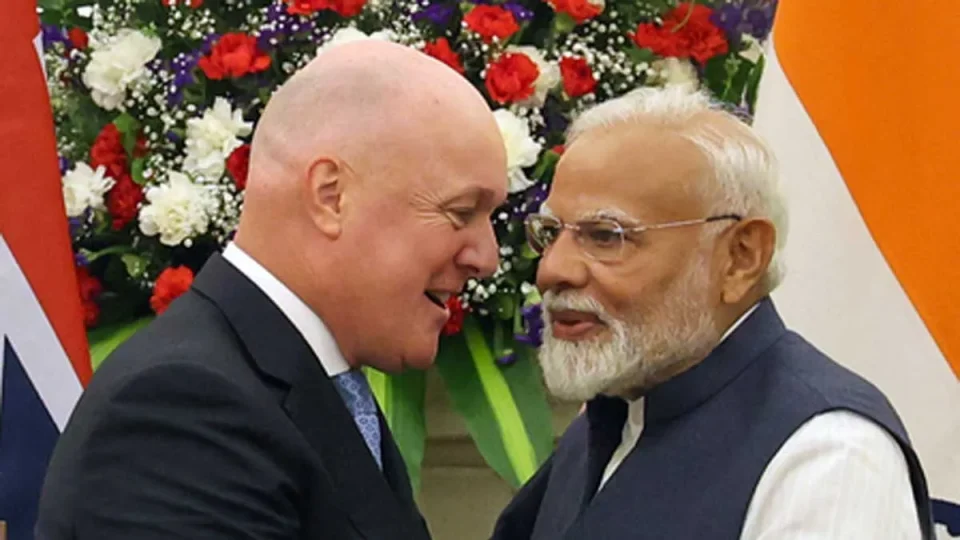

New Delhi/Wellington: India and New Zealand have officially concluded a landmark Free Trade Agreement (FTA) that will significantly reduce tariffs, expand services trade, and deepen economic cooperation between the two countries. The agreement is expected to nearly double bilateral trade within the next five years, according to statements from both governments.
New Zealand Prime Minister Christopher Luxon announced the development on Monday, saying the deal would cut or eliminate tariffs on most New Zealand exports to India. The agreement is projected to increase New Zealand’s exports to India by $1.1 billion to $1.3 billion annually over the next 20 years.
I’ve just spoken with India’s Prime Minister Narendra Modi following the conclusion of the NZ-India Free Trade Agreement.
— Christopher Luxon (@chrisluxonmp) December 22, 2025
The FTA reduces or removes tariffs on 95% of our exports to India. It’s forecast that NZ exports to India could increase $1.1B to $1.3B per year over the… pic.twitter.com/FEat7BQWOI
“I’ve just spoken with India’s Prime Minister Narendra Modi following the conclusion of the NZ–India Free Trade Agreement. Boosting trade means more Kiwi jobs, higher wages and more opportunities for hardworking New Zealanders,” Luxon said in a post on X. He added that India’s rapidly growing economy provides New Zealand businesses access to a consumer base of 1.4 billion people.
Tariff Reductions and Market Access
Under the agreement, India will ease tariffs on 70% of its tariff lines, accounting for nearly 95% of bilateral trade. Around 30% of tariff lines—including sensitive sectors such as dairy, animal products and select agricultural items—will remain outside the deal. This structure mirrors India’s approach in previous trade agreements, including its FTA with Australia.
New Zealand, meanwhile, will benefit from improved market access for key exports, while safeguards will be put in place to protect Indian farmers from sudden import surges.
Strong Focus on Services and Mobility
Services form a central pillar of the agreement. India has secured access in 118 service categories, including information technology and professional services.
As part of the mobility provisions, New Zealand will issue 5,000 temporary work visas for Indian nationals, valid for up to three years. These visas will cover sectors such as IT, engineering, healthcare, education, yoga, culinary arts and music.
The deal also includes a student mobility plan, allowing Indian students in New Zealand to work up to 20 hours per week without any quota, along with post-study work visa options.
Agriculture Safeguards
Sensitive agricultural products such as apples, kiwifruit and Manuka honey will be regulated through tariff-rate quotas, minimum import prices and seasonal restrictions. These measures aim to protect Indian farmers while ensuring stable trade flows.
Investment, IP and Strategic Cooperation
Beyond trade in goods and services, the FTA covers intellectual property rights, investment norms, customs procedures, and regulatory cooperation. The agreement also outlines a plan to facilitate $20 billion in New Zealand investment into India over the next 15 years.
In a statement, the Prime Minister’s Office said the FTA would “significantly deepen bilateral economic engagement, enhance market access, promote investment flows, and strengthen strategic cooperation.” Both leaders expressed confidence that the agreement would help double bilateral trade from the current $2.4 billion within five years.
Next Steps
The agreement will now undergo legal review and ratification in both countries. Formal signing is expected within the next three months, with implementation likely within eight months thereafter.