

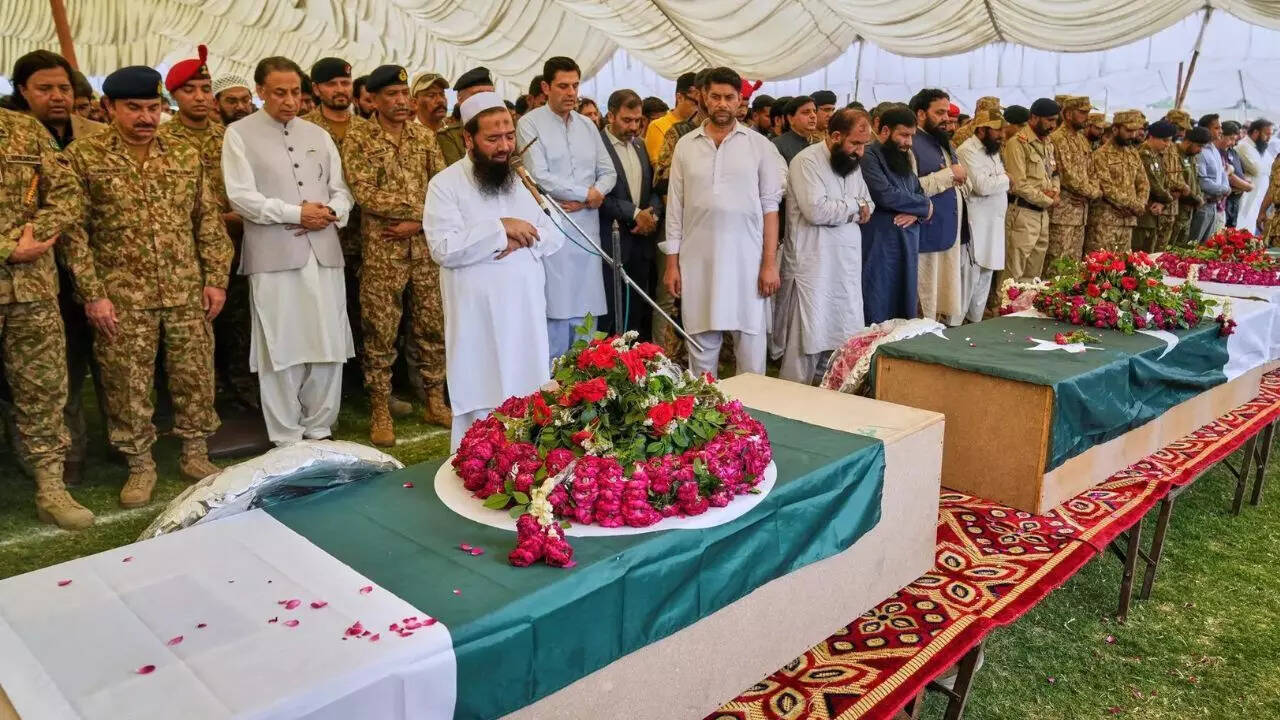

New Delhi [India]: India has released the names of senior Pakistani officials who attended the funeral of Lashkar-e-Taiba (LeT) commander Abdul Rauf, a US-designated global terrorist killed in Operation Sindoor.
According to the Ministry of Defence, the funeral was held in Muridke, Pakistan—an area known as a hub for LeT—and was attended by high-ranking members of the Pakistan Army and police officials.
Those present included Lt Gen Fayyaz Hussain, Major General Rao Imran, Brigadier Mohd Furqan from Administration, Usman Anwar (Pakistan Punjab legislator), and Malik Sohaib Ahmed.
Operation Sindoor, a strategic anti-terror strike launched by India, targeted nine terrorist camps in both Pakistan-occupied Jammu and Kashmir (PoJK) and Pakistan. The targeted locations in PoJK included Sawal Nala, Syedna Bilal, Gulpur, Barnala, and Abbas, while in Pakistan the targets were Bahawalpur, Muridke, Sarjal, and Mehmoona Joya.
The Defence Ministry also released a detailed list of 21 active terror camps in PoJK and Pakistan. These include:
Sawal Nala, Syedna Bilal, Maskar-e-Aqsa, Chelabandi, Abdullah bin Masood, Dulai, Garhi Habibullah, Batrasi, Balakot, Oghi, Boi, Sensa, Gulpur, Kotli, Barali, Dungi, Barnala, Mehmoona Joya, Sarjal, Muridke, and Bahawalpur.
Among those neutralized in the operation was Khalid Abu Akasha, a key arms smuggler linked to cross-border networks between Afghanistan and Pakistan. Akasha had received training from LeT, operated in Jammu & Kashmir, and recently moved to LeT headquarters in Muridke.
He was closely linked to central LeT/JuD members including Yahya Mujahid, Qari Yakub Sheikh, Abdul Rehman, Khalid Waleed, Engineer Haris Dar, and Abdul Rehman Abid.
Another major target was Mudassir Khadian Khas, an LeT operative who led the Muridke terror camp. Khas was the son-in-law of Hafiz Mohammad Saeed and worked as security-in-charge for Hafiz Abdul Rauf, Chairman of the Al Khidmat Committee. He also had connections with Hafiz Khalid Waleed, General Secretary of PMML in Lahore.
Mohammad Hassan Khan, a JeM terrorist, was also killed. He was the son of Mufti Asghar Khan Kashmiri, the JeM Operational Commander in PoJK. He operated from the Syedna Bilal camp and had ties to Ashiq Negroo (JeM Indian fugitive) and the Pulwama terror attack of 2019.
He reportedly accompanied his father to Shura meetings in Islamabad and coordinated with JeM operatives in Shakargarh including Mohammad Adnan Ali, Ali Kashif Jaan, and Mohammad Yasir.
The Defence Ministry confirmed that Hafiz Muhammed Jameel, a close aide and brother-in-law of JeM chief Maulana Masood Azhar, was also eliminated. Jameel oversaw operations from Bahawalpur, was a member of the JeM Shura, and frequently visited PoJK to recruit youth and raise funds for jihadist activities.
While India conducted precise air strikes on terror infrastructure, Pakistan retaliated by damaging a Gurudwara and a Madarasa in Poonch. India has showcased visuals of destroyed Pakistani drones in Ramnagar, Naushera, and Miran Sahib to emphasize its air defence readiness.
Amid these developments, India reaffirmed its position that all communication regarding military action will take place solely through DGMO-level channels, rejecting third-party involvement or backdoor diplomacy.
The escalation began after Pakistan’s drone attacks on Indian sites prompted India to launch Operation Sindoor, marking what the Defence Ministry referred to as a “new normal” in counter-terror operations.
On May 8, Foreign Secretary Vikram Misri stated:
“Pahalgam terror attack was ‘original escalation’ by Pakistan and India responded in ‘controlled, precise, measured, considered and non-escalatory’ manner through precise strikes on terror infrastructure early on Wednesday.”