

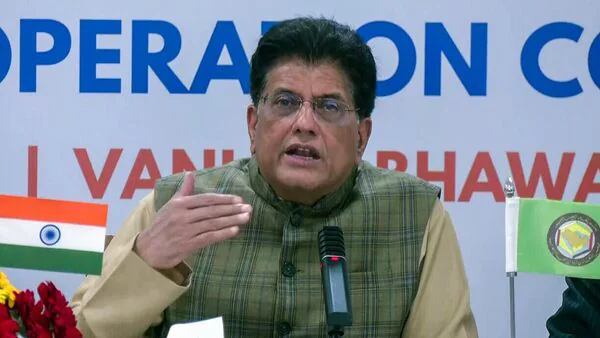

NEW DELHI — In a landmark move for India’s “Look West” policy, Union Commerce Minister Piyush Goyal formally launched negotiations for a Free Trade Agreement (FTA) with the Gulf Cooperation Council (GCC) on Thursday, February 5, 2026. By signing the Terms of Reference (ToR) in New Delhi, both sides have revived a process that had been largely stalled for nearly two decades.
The timing is critical, as India recently concluded “the mother of all deals” with the European Union in late January 2026 and a major de-escalatory trade pact with the United States earlier this week.
1. The Scope of the India-GCC FTA
The GCC includes Saudi Arabia, the UAE, Qatar, Kuwait, Oman, and Bahrain. Together, they represent a global economic powerhouse with a combined GDP of $2.3 trillion.
- Current Trade: Bilateral trade stood at $178.56 billion in FY 2024-25, accounting for over 15% of India’s total global trade.
- Target Sectors: The deal is expected to provide zero-duty or preferential access for Indian food processing, infrastructure, petrochemicals, ICT, and textiles.
- The “Living Bridge”: Minister Goyal emphasized the 10 million-strong Indian diaspora in the Gulf as a vital economic and cultural link that this FTA will further protect and empower.
2. Geopolitical Context: The Saudi-Pak Factor
The revival of these talks follows a complex shift in regional security:
- September 2025 Pact: Saudi Arabia and Pakistan signed a Strategic Mutual Defence Agreement (SMDA), a “NATO-like” pact where aggression against one is treated as aggression against both.
- India’s Reaction: While New Delhi is monitoring the SMDA’s impact on national security, the launch of the GCC FTA suggests that economic ties between India and the Gulf remain on a separate, high-priority track.
- UAE’s Stance: Conversely, ties between the UAE and Pakistan have reportedly cooled, following the UAE’s scrapping of a major airport deal in Islamabad and its deepening $200 billion trade target with India for 2032.
3. India’s Recent Trade “Grand Slam”
The GCC negotiations are the latest in a series of aggressive trade expansions by the Indian government in early 2026.
| Trade Partner | Date Signed / Announced | Key Highlights |
| European Union (EU) | Jan 27, 2026 | World’s largest free trade zone; 99% duty-free access for Indian goods. |
| United States (USA) | Feb 2, 2026 | De-escalation of tariffs; first tranche of deal expected by mid-March. |
| GCC (Six Nations) | Feb 5, 2026 | Terms of Reference signed; first round of talks set for Riyadh. |
4. What This Means for Businesses and Workers
- For Exporters: Significant tariff reductions on engineering goods, rice, and gems & jewellery.
- For Professionals: Easier labor mobility for Indian skilled workers and students to the Gulf region.
- For Investors: A predictable legal framework to encourage the $31 billion+ in cumulative FDI from the Gulf into India’s infrastructure and energy sectors.