

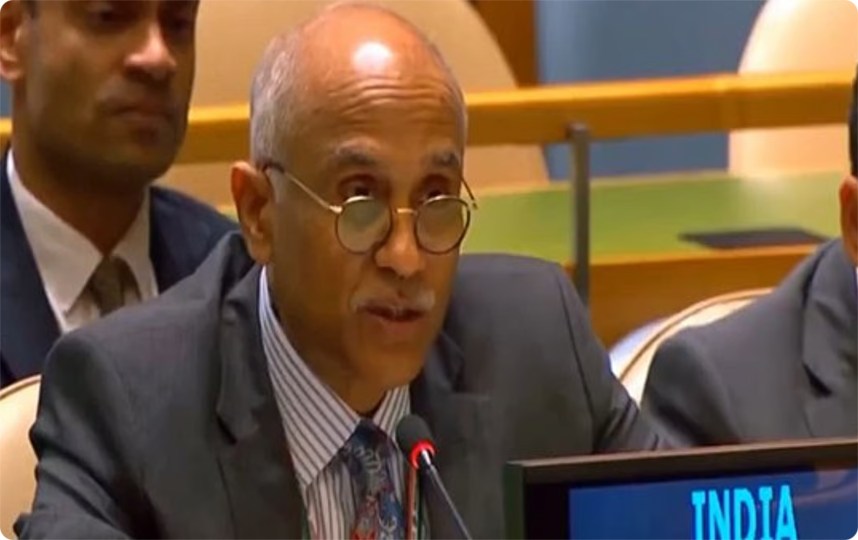

United Nations, July 8: India abstained from voting on the United Nations General Assembly (UNGA) resolution on the situation in Afghanistan on Monday, expressing concern that a “business as usual” approach will not achieve meaningful outcomes for the Afghan people without fresh, targeted initiatives.
The resolution, titled “The Situation in Afghanistan”, was adopted with 116 votes in favour, 2 against (Israel, United States), and 12 abstentions, including India.
Delivering India’s explanation of vote, Permanent Representative to the UN, Parvathaneni Harish, said:
“India is closely monitoring the security situation in Afghanistan. The international community must direct its coordinated efforts towards ensuring that entities and individuals designated by the UN Security Council — the Al Qaeda and their affiliates, ISIL and their affiliates, including Lashkar-e-Tayyiba and Jaish-e-Mohammed, along with their regional sponsors who facilitate their operations, no longer exploit the Afghan territory for terrorist activities.”
The resolution called on Afghanistan to uphold human rights, comply with international law, and take strong action against terrorism amid a growing humanitarian crisis.
Harish referred to recent diplomatic engagements, including a conversation between External Affairs Minister S. Jaishankar and the Taliban-appointed Acting Foreign Minister, noting:
“We welcome the strong condemnation of the Pahalgam terrorist attack of April 22, 2025, by the Afghan side.”
He emphasised that India’s stance on Afghanistan is rooted in its “longstanding friendship and special relationship” with the Afghan people and its geostrategic interest in the region.
“India’s approach to Afghanistan — as its contiguous neighbour with deep historical and cultural ties — has always been guided by our longstanding friendship and special relationship with the Afghan people. As a long-standing partner, India has direct stakes in ensuring peace and stability in Afghanistan.”
Harish said India continues to actively engage regional and international partners, citing participation in Doha meetings and other regional forums. He also highlighted India’s humanitarian aid, including:
- 50,000 metric tons of wheat
- 330+ metric tons of medicines and vaccines
- 40,000 litres of Malathion pesticide
- 58.6 metric tons of essential items
Additionally, he noted cooperation with UNODC to support drug rehabilitation programmes, especially for women, and mentioned India’s 2,000 scholarships to Afghan students since 2023, nearly 600 of whom are girls and women.
On policy strategy, he warned against relying solely on punitive measures:
“Any coherent policy to address a post-conflict situation must combine a mix of policy instruments — incentivizing positive behaviour and disincentivizing harmful actions. An approach focused only on punitive measures, in our view, is unlikely to succeed.”
India also criticised the lack of innovation in policy direction since the Taliban’s takeover in August 2021:
“A ‘business as usual’ approach, without new and targeted initiatives, is unlikely to deliver the outcomes the international community envisions for the Afghan people.”
Concluding his address, Harish reiterated India’s deep-rooted ties and ongoing commitment to Afghanistan’s humanitarian and developmental needs:
“I would like to reiterate India’s historic ties with the people of Afghanistan and our enduring commitment to meeting their humanitarian and developmental needs. While we remain committed to continued engagement with all relevant stakeholders and broadly support the international community’s efforts towards a stable, peaceful and prosperous Afghanistan, India has decided to abstain on this resolution.”