

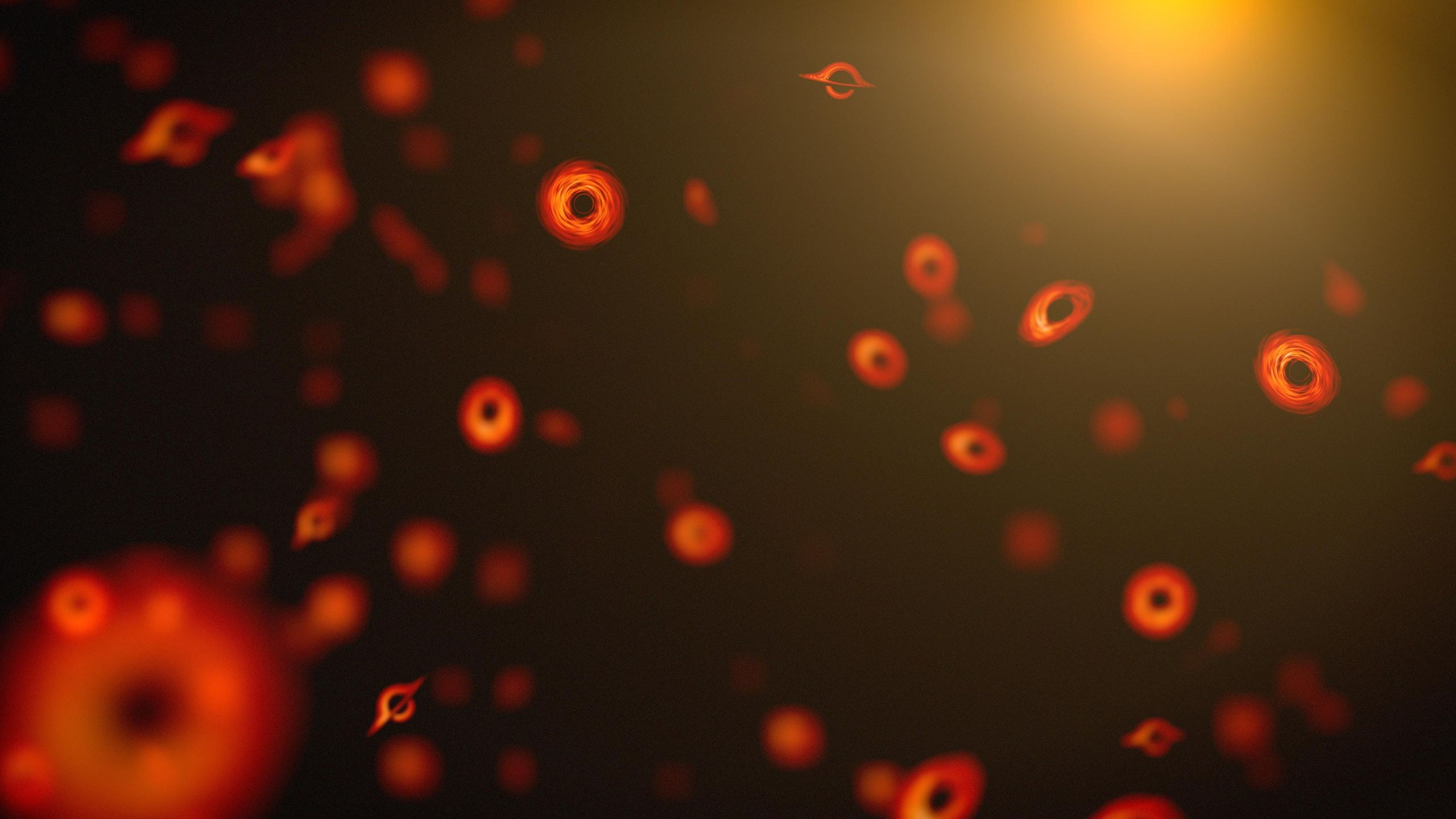

In 2023, astronomers detected an extraordinarily energetic subatomic particle striking Earth — a finding that left scientists puzzled because no known cosmic phenomenon could explain its immense energy. Now, a team of researchers has put forward a bold theory: the mysterious particle may be the remnant of an exploding primordial black hole, a hypothetical object formed moments after the Big Bang.
If confirmed, the discovery could mark the first observational evidence of Hawking radiation, a phenomenon predicted by Stephen Hawking more than four decades ago, and may also shed light on the elusive nature of dark matter.
Primordial Black Holes and Hawking Radiation
Unlike stellar black holes, which form from the collapse of massive stars, primordial black holes are thought to have emerged from extreme density fluctuations during the universe’s earliest fractions of a second. These black holes would be far smaller than their stellar counterparts — some possibly no larger than an asteroid.
According to the new research, such tiny black holes should emit Hawking radiation, slowly losing mass over time while growing hotter as they shrink. This process accelerates near the end of their life cycle.
“The lighter the black hole is, the hotter it should be,” said Andrea Thamm, a physicist at the University of Massachusetts.
“And just before the end, it goes boom.”
That final “boom” would be a brief but violent explosion, releasing an intense burst of particles into space — a fleeting event scientists believe could finally be detectable with modern instruments.
The Neutrino That Shouldn’t Exist
The mystery particle was detected by the KM3NeT neutrino detector in the Mediterranean Sea. The observatory recorded a cosmic neutrino with an energy of around 100 peta-electronvolts (PeV) — roughly 100,000 times more energetic than particles produced by the Large Hadron Collider.
Such extreme energy levels cannot be explained by known astrophysical sources like supernovae, pulsars or active galactic nuclei.
Adding to the mystery, the IceCube neutrino detector at the South Pole — one of the world’s most sensitive observatories — did not detect a similar signal, raising questions about the neutrino’s origin.
A ‘Dark Charge’ and a New Explanation
Researchers at the University of Massachusetts propose that primordial black holes may carry a previously unknown “dark charge”, similar to electric charge but much heavier and invisible to conventional detectors.
This dark charge could explain why IceCube failed to register the event, while KM3NeT succeeded. According to the team, when a charged primordial black hole explodes, it could release ultra-high-energy neutrinos capable of reaching Earth but evading some detection methods.
If proven, the theory would not only explain the enigmatic neutrino but also open a new window into dark matter physics, suggesting primordial black holes could account for at least part of the universe’s missing mass.
Why It Matters
An exploding primordial black hole would represent:
- The first direct evidence of Hawking radiation
- A breakthrough in understanding dark matter
- Proof that remnants from the earliest moments of the universe are still observable today
While the idea remains theoretical, scientists say upcoming neutrino detections and improved observatories could soon confirm — or rule out — this extraordinary possibility.