

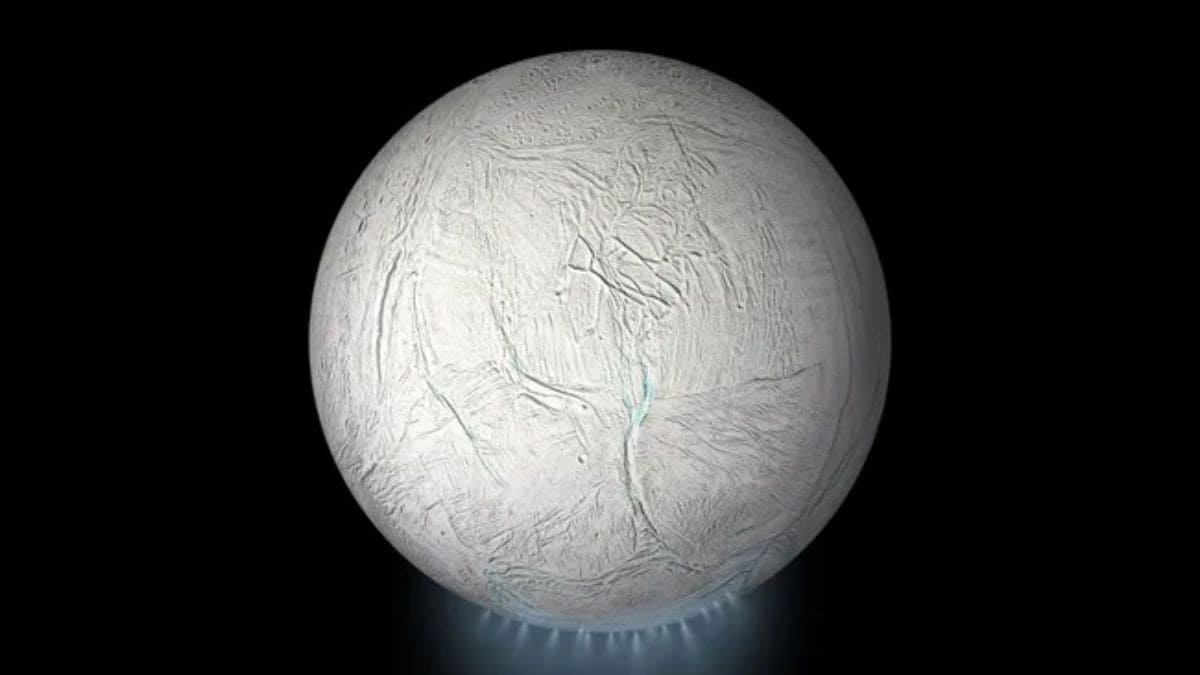

A groundbreaking study suggests that several small icy moons in the outer solar system may experience boiling oceans beneath their frozen surfaces—not from heat, but from sudden drops in pressure. According to researchers, these moons, which include Mimas, Enceladus, and Miranda, may undergo low-temperature boiling episodes under their ice shells, potentially influencing their surface activity and even creating brief environments where life could survive.
These moons are already believed to harbour subsurface oceans, but the new findings reveal that as their ice shells thin, the pressure on the oceans beneath sharply decreases. This sudden pressure drop may push pockets of water to reach the “triple point”—a rare state where ice, liquid water, and vapour all coexist simultaneously. Remarkably, boiling at this triple point happens close to 0°C, unlike typical boiling on Earth that requires high temperatures.
Study Reveals How Low-Temperature Boiling Shapes Icy Moons
Published in Nature Astronomy, the study led by Maxwell Rudolph explores how the thinning of icy crusts on cold moons can trigger pressure-driven boiling. Rudolph explained that the mechanism is completely different from the familiar high-heat boiling we see on Earth. Instead, the reduced pressure above the oceans makes the water boil at extremely low temperatures.
This process can also generate powerful mechanical effects. According to the research team, the boiling may drive open cracks in the ice shells, allowing water from the subsurface oceans—potentially rich in biological ingredients—to escape onto the surface. Such outflows could help explain:
- The long-observed geysers and plumes on Enceladus,
- The youthful signs of resurfacing and activity recently detected on Mimas,
- Stress patterns and tectonic features seen on Uranian moons like Miranda and Titania.
Smaller icy moons are more likely to reach these boiling conditions, researchers say. Larger moons, such as Titania, may instead experience structural failure and cracking rather than low-temperature boiling.
Boiling May Also Trap Gases in Surface Ice
The team also suggests that boiling episodes could release gases from the oceans, which may later become trapped in icy deposits known as clathrates. These gas-filled ice structures could play a major role in shaping a moon’s geology.
Future research aims to understand how these trapped gases impact:
- surface morphology,
- cryovolcanic activity,
- and whether they can serve as observable markers of hidden oceans.
A New Clue in the Search for Extraterrestrial Life
If these findings are confirmed, they would add to a growing body of evidence that icy moons—despite their extreme cold—remain one of the most promising places in the solar system to search for life. Even with drastic pressure changes and temporary boiling layers, scientists believe that deeper regions of subsurface oceans may remain stable enough to support microbial life.
This study reinforces the idea that the outer solar system, filled with quietly active worlds beneath frozen exteriors, may be far more dynamic and life-friendly than previously imagined.