

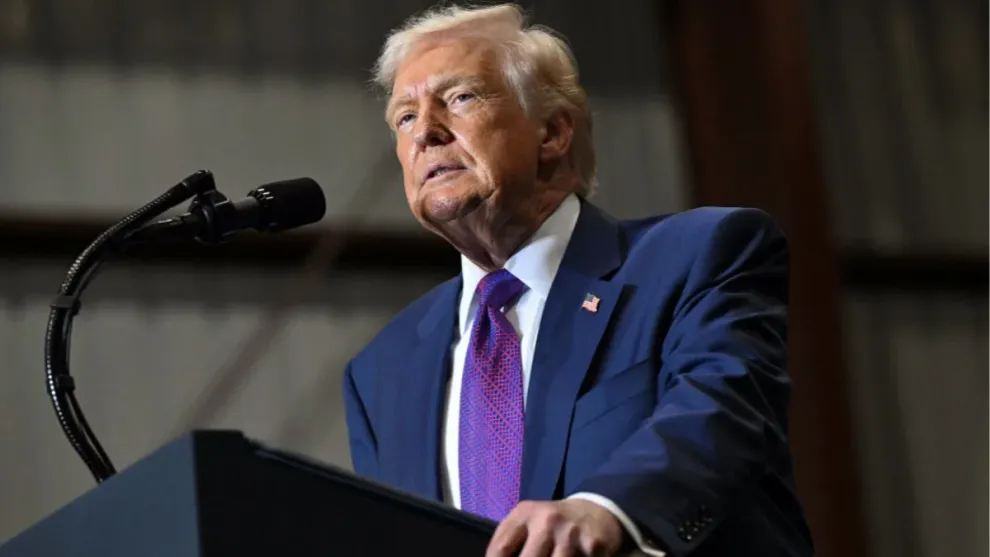

WASHINGTON, D.C. — Standing in the Brady Press Briefing Room, a visibly frustrated President Trump blasted the Supreme Court’s decision as “ridiculous,” arguing that the ruling created a logical fallacy where he has the power to destroy a nation’s economy through an embargo but lacks the power to tax its goods.
The “Logic of Destruction” Argument
Trump framed the court’s opinion as an attack on American protectionism, highlighting what he sees as a legal contradiction:
- The Embargo Power: Trump noted that under IEEPA, he retains the power to completely cut off trade or impose total embargoes.
- The Tariff Restriction: “I can destroy the trade. I can destroy the country… but I can’t charge $1,” Trump remarked. “This must have been done to protect those other countries. Certainly not the United States.”
The New Legal Weapon: Section 122
To keep his trade wall intact, Trump pivoted to Section 122 of the Trade Act of 1974.
- The Mechanism: This provision allows the President to impose import duties of up to 15% to address “large and serious” balance-of-payments deficits.
- The Deadline: Unlike the previous open-ended tariffs, these are limited to 150 days. Any extension beyond that period requires Congressional approval.
- Legal Shield: Because the measure is time-bound, legal experts suggest it may expire before any new court challenges can reach a final verdict.
Impact on the India Trade Deal
Despite the global reset, Trump moved to reassure markets regarding the recently established US-India Trade Framework.
- 10% Baseline: White House officials clarified that India’s punitive tariffs (previously as high as 25-26%) will temporarily drop to the 10% global baseline.
- “They Pay the Tariffs”: Trump insisted the deal’s core—India buying $500 billion in US goods and restricting Russian oil—remains solid. “Nothing changes. They will be paying tariffs and we will not be paying tariffs,” he asserted.
Comparative Snapshot: Old vs. New Tariffs
| Feature | Invalidated IEEPA Tariffs | New Section 122 Tariffs |
| Rate | Variable (10% to 145%) | Flat 10% Global |
| Duration | Indefinite | 150 Days (Max) |
| Legal Basis | National Emergency (IEEPA) | Balance-of-Payments (1974 Act) |
| Congress Role | Bypassed | Must approve extension |