

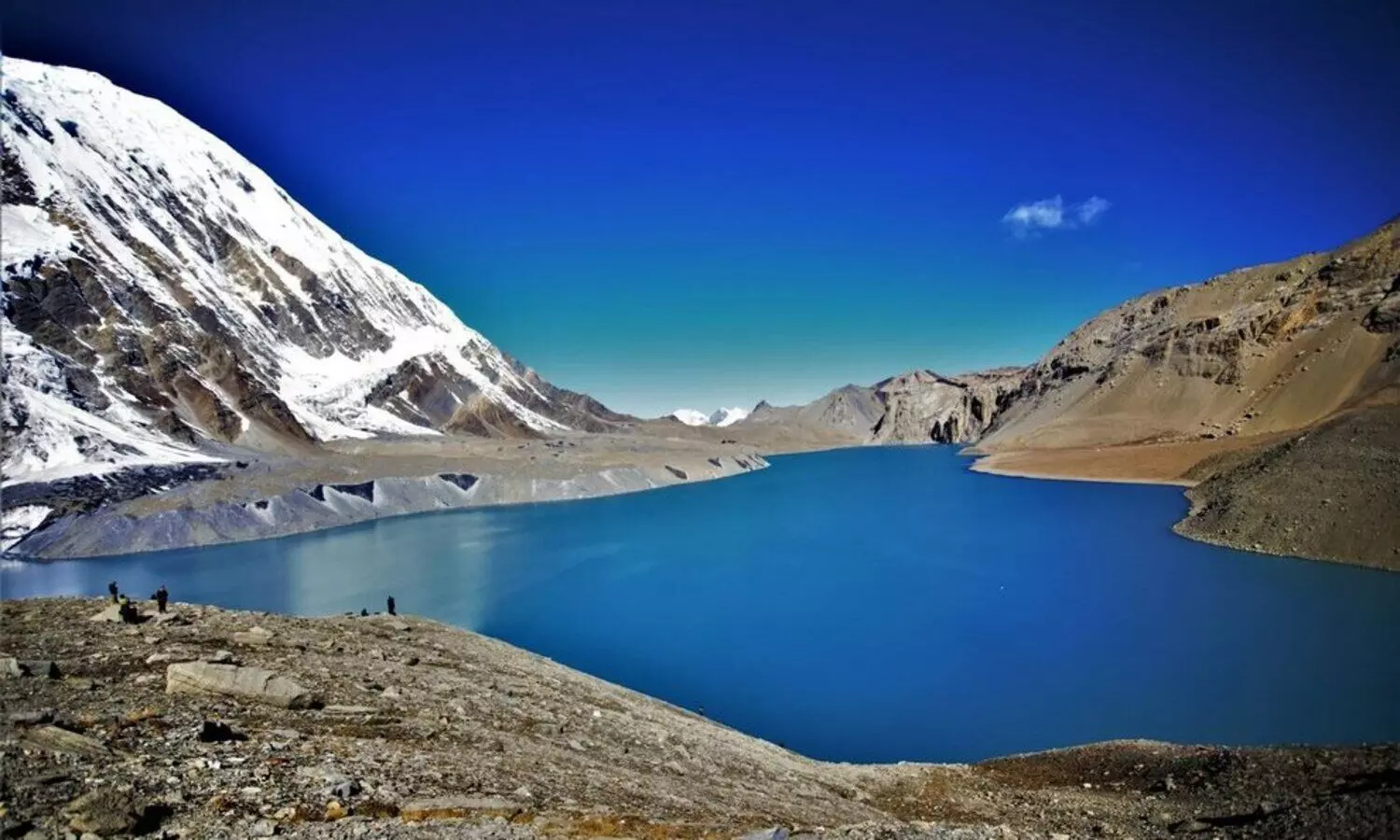

The Central Water Commission (CWC) says that glacial lakes and other bodies of water in the Himalayan region have grown by 9.24% over the past 14 years. This shows how climate change is having a bigger and bigger effect on one of the world’s most fragile ecosystems.
The survey added that the overall area of glacier lakes and water bodies grew from 5.30 lakh hectares in 2011 to 5.79 lakh hectares in 2025.
The CWC’s Monthly Monitoring Report for August, which hasn’t been made public yet, uses high-resolution satellite data to keep an eye on glacial lakes. It said that melting glaciers and growing glacial lakes are two of the most obvious signs of global warming in the Himalayas.
Trends in Growth and Decline
The CWC used Sentinel satellite data through Google Earth Engine to look at 2,843 glacial lakes and bodies of water. They found that 1,435 lakes had more water spread area, whereas 1,008 lakes had less water spread area between 2011 and 2025.
The survey said that 428 glacial lakes in India had grown significantly and need “vigorous monitoring for disaster preparedness.” These are:
Ladakh has 133 lakes.
50 in Jammu and Kashmir
13 in Himachal Pradesh
7 in Uttarakhand
44 in Sikkim
181 in Arunachal Pradesh
India’s glacier lakes’ total water spread area expanded by 22.56%, from 1,995 hectares in 2011 to 2,445 hectares in 2025.
The risk of Glacial Lake Outburst Floods (GLOFs) is going up.
The paper said that the growth of glacial lakes makes Glacial Lake Outburst Floods (GLOFs) more likely. These floods happen when unstable moraine dams break and force huge amounts of water to flow. These events can send huge amounts of water downstream, putting lives, infrastructure, and towns at risk.
The CWC stressed that it is not yet able to directly foresee these kinds of incidents, which is why continual monitoring is so important.
The research said, “With current knowledge, predicting outburst events directly isn’t feasible.” It stressed the need for ongoing satellite monitoring and cooperation between disaster management agencies.
Data and Organization
To improve early warning systems, the monthly monitoring reports are periodically sent to disaster management authorities at the state and central levels. The reports are also available to the public on the CWC website, which helps people get ready for disasters.
The Glacial Lake Atlas of Indian River Basins 2023 says that there are 28,043 glacial lakes larger than 0.25 hectares in the Himalayan river basins. Of them, 7,570 are in India.
Final Thoughts
The CWC’s findings emphasize a clear trend: increasing glacial retreat and expanding lake volumes are altering the Himalayan environment. Experts say that proactive monitoring, research, and mitigation actions are necessary to stop potential crisis scenarios in sensitive mountain areas as climate change continues to speed up.