

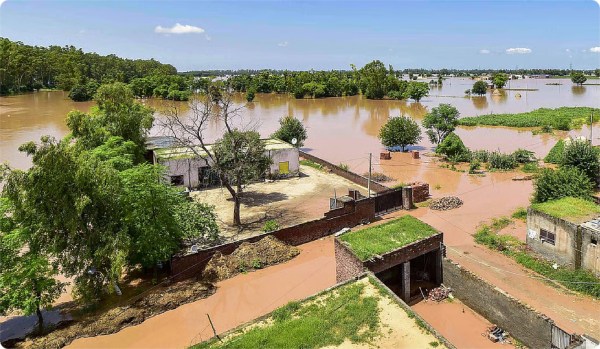

CHANDIGARH — Flash floods have happened because of the monsoon rains, and daily life has been affected in several areas near the India-Pakistan border, especially in Punjab and Jammu & Kashmir. After a night of nonstop rain, the Ujh and Ravi rivers and their tributaries overflowed their banks on Sunday, flooding roads and fields.
Officials say that a 30- to 40-foot length of road near the Jalalian drain was swept away, stopping traffic. Lal Chand Kataruchak, a member of the Punjab Cabinet, went to the areas that were hit to see how bad the damage was. He said that the situation in villages along the border was bad because of the heavy flow of water. He told the people that the state government will pay for their damages and that “the crops of farmers have also been hit.” He also said that a lot of communities in the Bamial area were affected by a break in the Jalalian bridge.
In the Mukerian subdivision of Hoshiarpur district, on the other hand, the Chakki Khad, a tributary of the Beas river, overflowed its banks. According to Sub Divisional Officer Sukhpreet Singh, the Chakki Khad was sending a huge amount of water into the Beas—over 1.34 lakh cusecs. Sub Divisional Magistrate Ankur Mohindru said that the water has not yet reached residences, even though it has reached farms and roadways in a number of villages. Authorities have started giving out aid and are moving families to safety as needed.
Amit Kumar Panchal, the Deputy Commissioner of Kapurthala district, said that the government is keeping an eye on the water levels of the Beas and has told people who live in low-lying areas to be careful. Panchal told the public that the district administration is ready for anything and has sent State Disaster Response Force (SDRF) teams to deal with any problems that may come up. There are also relief centers in Lakh Warian and Mand Kuka that offer enough food, shelter, and medicine for the those who need it.
The strong rains are part of a larger monsoon season that is impacting the area. Officials are hopeful that the water levels will drop soon, but the flooding of farmland has farmers quite worried, especially those who grow rice and sugarcane.