

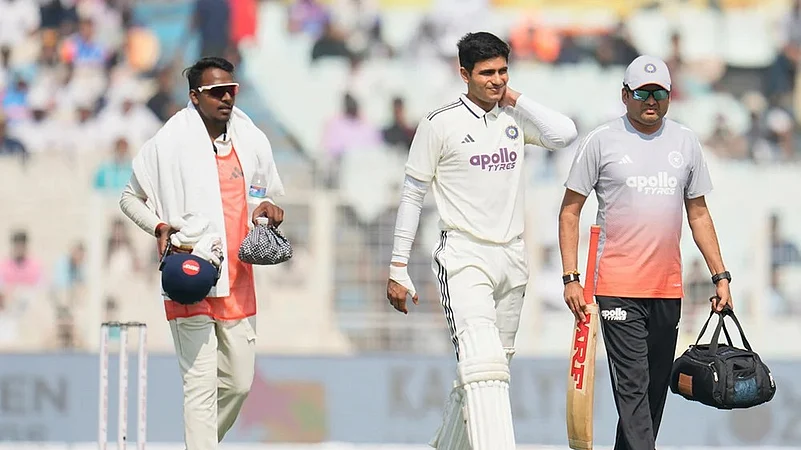

India’s assistant coach Ryan ten Doeschate has confirmed that the team will implement a significant reshuffle in the batting order for the second Test against South Africa in Guwahati, following captain Shubman Gill’s neck injury that has ruled him out for the remainder of the series. The absence of Gill has prompted India to rethink their lineup balance and redefine player roles for the crucial match.
Ten Doeschate said the team had already mapped out a flexible but clear batting structure for the rest of the series, and the players had been informed of their updated responsibilities.
The Indian team had made an experimental move in the first Test in Kolkata by promoting Washington Sundar to the No. 3 position. However, the assistant coach signalled that this strategy would be reversed in Guwahati. Sundar is now expected to return to his more familiar lower-middle-order role at No. 8 — a position where India rely on both his calm batting presence and his off-spin.
“We’re pretty certain on who’s going to bat where, and the players have been informed,” ten Doeschate said after India restricted South Africa to 247 for 6 on the opening day at the Barsapara Cricket Stadium.
He emphasised the importance of flexibility: “We keep talking about versatile players and players that can bat in different positions, and we’re asking guys to do on the day whatever’s best for the team. So there’s going to be a reshuffling of the order.”
With Gill absent, Sai Sudharsan — brought into the XI for this match — is expected to slot into the No. 3 position, which is his natural role. Dhruv Jurel, who batted at No. 4 in the second innings of the Kolkata Test, is likely to continue at that number to maintain the right-hand/left-hand balance in the middle order. A specialist batter is expected to occupy both No. 3 and No. 4, ensuring stability at the top.
Kuldeep Yadav Leads India’s Fightback on Day 1
The discussions around the batting order came after India’s strong performance with the ball on Day 1. Kuldeep Yadav was the standout performer, picking up 3 for 61 on a red-soil pitch that offered extra bounce and grip. Ten Doeschate praised the left-arm wrist-spinner for making the most of favourable conditions.
“We know Kuldeep’s strike rate is phenomenal. He’s a wicket-taker,” he said. “Maybe the fact that he gets overspin, and with the red soil and a little more pace in the wicket, he was slightly more effective today. For him to pick up three wickets and get us a foothold in the game is a real bonus.”
South Africa’s total of 247 for 6 was built on contributions from Aiden Markram (38), Ryan Rickelton (35), Tristan Stubbs (49), and captain Temba Bavuma (41). Jasprit Bumrah, Mohammed Siraj, and Ravindra Jadeja chipped in with a wicket each.
Conditions Favour India, but Toss Still a Decisive Factor
Reflecting on India’s 30-run defeat on a turning pitch in Kolkata, ten Doeschate said the team believes the harder, truer surfaces such as the one in Guwahati suit their style of play better.
“My personal view is the wicket rarely determines who wins the game. If we’d played better in Kolkata, I feel we could have won,” he said. “But these wickets maybe do suit us a little better. You’ve got to be prepared to fight really hard.”
He added that the toss may become even more influential under such conditions.
“Maybe the toss becomes even more important here,” he noted. “If you lose it, you have to put on a display like today and fight for every run to stay in the game.”