

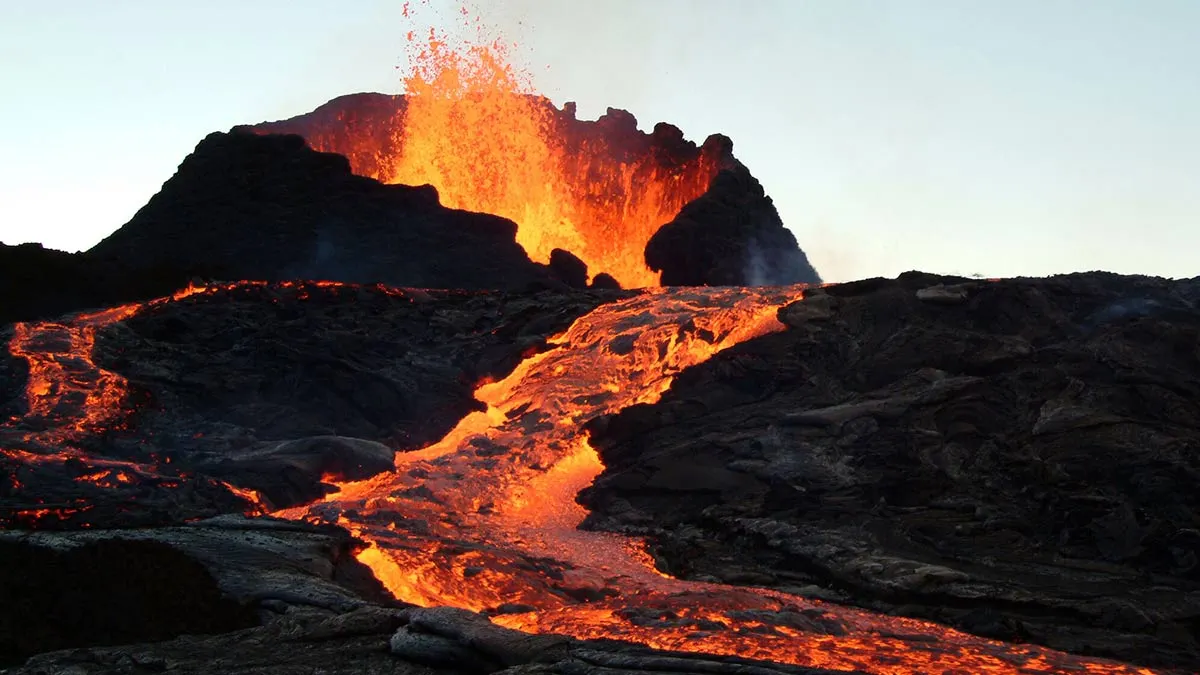

CAMBRIDGE, UK — A groundbreaking study by scientists at Cambridge University has rewritten a chapter of Earth’s volcanic history, revealing how a single, powerful plume of hot rock deep beneath Iceland caused widespread eruptions across the North Atlantic about 60 million years ago. The research suggests that hidden weak zones within the Earth’s plates acted like funnels, directing the plume’s heat and magma over a vast region that included Greenland, Iceland, Scotland, and Ireland.
The discovery was made using seismic tomography, a technique similar to a medical CT scan, to create a detailed image of the Earth’s crust. This “CT scan” of the planet’s interior revealed a band of unusually thin rock, known as lithosphere, beneath the Irish Sea. This weak zone perfectly aligned with ancient volcanic fields, including the iconic basalt columns of Northern Ireland’s Giant’s Causeway, which the study identifies as relics of this ancient volcanic event. The data showed that the Icelandic mantle plume—a rising column of hot rock from the deep Earth—was funneled along this thin corridor, feeding distant volcanic centers.
This finding challenges the long-held theory that multiple independent plumes were needed to explain the scattered volcanic fields of the North Atlantic Igneous Province. Instead, the study posits that one single “hot spot” was responsible for the far-flung eruptions. The research demonstrates how a deep-seated heat source can affect a much wider area by eroding and thinning the crust along these pre-existing weak zones, effectively creating pathways for volcanic activity.
The “scars” of this ancient activity are still visible today. The same corridors of thinned crust are now regions where seismic activity in Britain and Ireland is concentrated. This is because the thinned crust allows for more efficient heat transfer from the deep Earth, which can influence earthquake patterns. The study’s authors also suggest that these areas could hold potential for geothermal energy, as the trapped deep-Earth heat provides a promising source for sustainable power.
By offering a new perspective on the interaction between mantle plumes and the Earth’s lithosphere, this research not only solves a long-standing geological mystery but also provides a new framework for understanding our planet’s inner workings, from ancient landforms to modern-day seismic and energy prospects.