

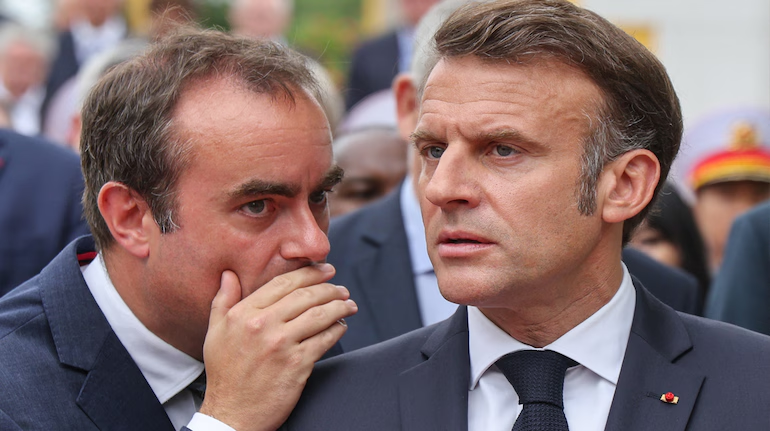

French President Emmanuel Macron is on the hunt for his sixth prime minister in just under two years, a situation that underscores the severity of France’s current political crisis. The announcement by Macron’s office on Wednesday confirmed that a new prime minister would be appointed within 48 hours, following the resignation of Sébastien Lecornu on Monday.
Lecornu’s tenure was exceptionally brief, lasting only a few weeks after he assumed office and a few hours after announcing his cabinet. This makes his the shortest-lived administration in modern France.
The Unworkable Task: Why Lecornu Resigned
Lecornu’s resignation came after weeks spent negotiating with political parties, unions, and business leaders. He ultimately concluded that the role had become “unworkable” because the fundamental conditions for governing were not in place.
His main failure was the inability to secure consensus on the government’s core domestic objective: passing the next year’s budget.
“Being prime minister is a difficult task, doubtless even a bit harder at the moment, but one cannot be prime minister when the conditions aren’t fulfilled,” Lecornu stated. Following his resignation, he was asked to continue talks with political groups in the National Assembly to de-escalate the crisis.
Rival parties immediately weighed in on the appointment process. The Socialists insisted that Macron should appoint a candidate from the left, while the conservative Republicans quickly declared that they would not support a leftist prime minister.
The Root of the Crisis: A Hung Parliament
The unprecedented political turbulence stems from the hung Parliament that resulted from the snap legislative elections Macron called in July 2024, a gamble that backfired on his centrist alliance.
Since then, the National Assembly has been defined by a lack of cooperation, with the President’s rivals on the far left and far right frequently uniting to vote against the minority governments. This strategy has successfully toppled five prime ministers since September 2024.
Macron has reiterated that he will not step down and intends to complete his second and final term, which ends in 2027. However, the continuous cycle of resignations poses a serious threat to the stability of his administration.
Macron’s Five Fallen Prime Ministers (Since May 2022):
| Prime Minister | Term of Service | Key Reason for Resignation/Removal |
| 1. Élisabeth Borne | May 2022 to Jan 2024 | Used special legislative powers to avoid a parliamentary vote on the controversial rise in the retirement age, leading to mass protests and her resignation. |
| 2. Gabriel Attal | January 2024 to September 2024 | Unable to pass his plan to cut unemployment benefits; the hung parliament following the snap elections led to his resignation. |
| 3. Michel Barnier | September 2024 to December 2024 | Removed after being defeated by a no-confidence vote in the National Assembly. |
| 4. François Bayrou | December 2024 to September 2025 | Failed to pass his €44 million austerity budget, which included freezing pensions and social spending. |
| 5. Sébastien Lecornu | September 2025 to October 2025 | Resigned after failing to secure a consensus on the next year’s budget due to the unworkable hung parliament situation. |
Export to Sheets