

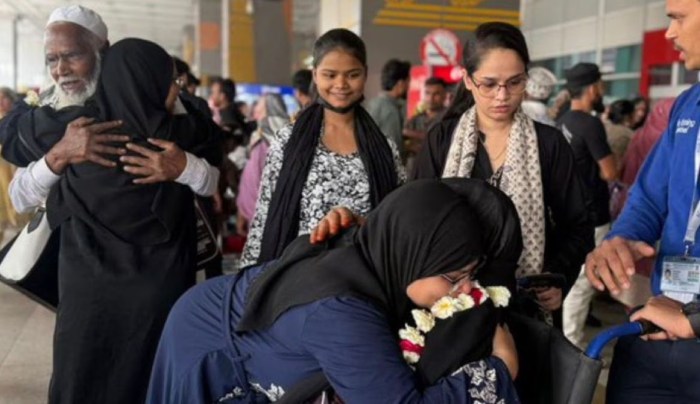

NEW DELHI / SRINAGAR — On Sunday, March 15, 2026, the first major batch of Indian students and pilgrims—over 70 individuals, predominantly from Jammu and Kashmir—safely reached Terminal 3 of Indira Gandhi International Airport. Their arrival marks the first successful phase of a complex, multinational repatriation effort coordinated by the Ministry of External Affairs (MEA) and the Jammu and Kashmir Students Association (JKSA).
1. The “Armenia Corridor”: A 96-Hour Escape
With Iranian airspace closed due to the conflict that began on February 28, the students undertook a grueling four-day journey to reach Indian soil.
- The Route: Students traveled by bus from various Iranian universities to the Armenia land border. After crossing into Armenia, they reached Yerevan, boarded a Flydubai flight to Dubai, and finally took a connecting flight to New Delhi.
- The Cost: Students reported paying approximately ₹55,000 each for the journey, often borrowing money from one another as international banking transfers to Iran have been severed.
2. Life Under Bombardment: “Shaking Buildings & Fighter Jets”
Returning students shared harrowing accounts of the escalating violence in Iran:
- Close Calls: Naina Toiba, an MBBS student from Anantnag, described a bombing that occurred just 200 meters from her apartment, shattering windows and forcing her to flee.
- Target Shift: While early strikes targeted military infrastructure, students noted a terrifying shift as schools, hospitals, and residential areas began facing aerial bombardment.
- Coping Mechanisms: With no internet or television, students spent their final days in Iran “stocking grains” and “turning to books” to distract themselves from the roar of fighter jets.
3. Bureaucratic Delays & Academic Stress
Many students were initially hesitant to leave despite earlier MEA advisories.
- University Pressure: Institutions like Urmia University of Medical Sciences and Tehran University reportedly warned students that leaving before final exams (postponed from March 5) could result in academic failure.
- Communication Blackout: Internet disruptions made it nearly impossible for students to coordinate with their families or the embassy, leading to a sense of hopelessness that only dissipated once they crossed into Armenia.
4. Status of Operation Sindhu
While this first batch has brought relief to many families in Kashmir, the mission is far from over.
- Remaining Stranded: Approximately 1,100 to 1,500 Indian students are still believed to be in Iran.
- Government Response: The J&K Government has arranged AC sleeper buses at Terminal 3 to transport the returnees directly to their homes in Jammu and Kashmir.
- Full-Scale Call: JKSA Convenor Nasir Khuehami has urged the Prime Minister to launch a full-scale airlift, similar to Operation Ganga (Ukraine), rather than relying solely on commercial transit routes.
Evacuation Snapshot: March 16, 2026
| Metric | Details |
| First Batch Size | 70+ (Students & Pilgrims) |
| Primary Universities | Urmia, Tehran University of Medical Sciences |
| Transit Hubs | Yerevan (Armenia) & Dubai (UAE) |
| Status of Remaining | ~1,000+ still in Iran (Kerman group moved to Qom) |
| Onward Travel | J&K Govt provided AC Sleeper coaches from Delhi |