

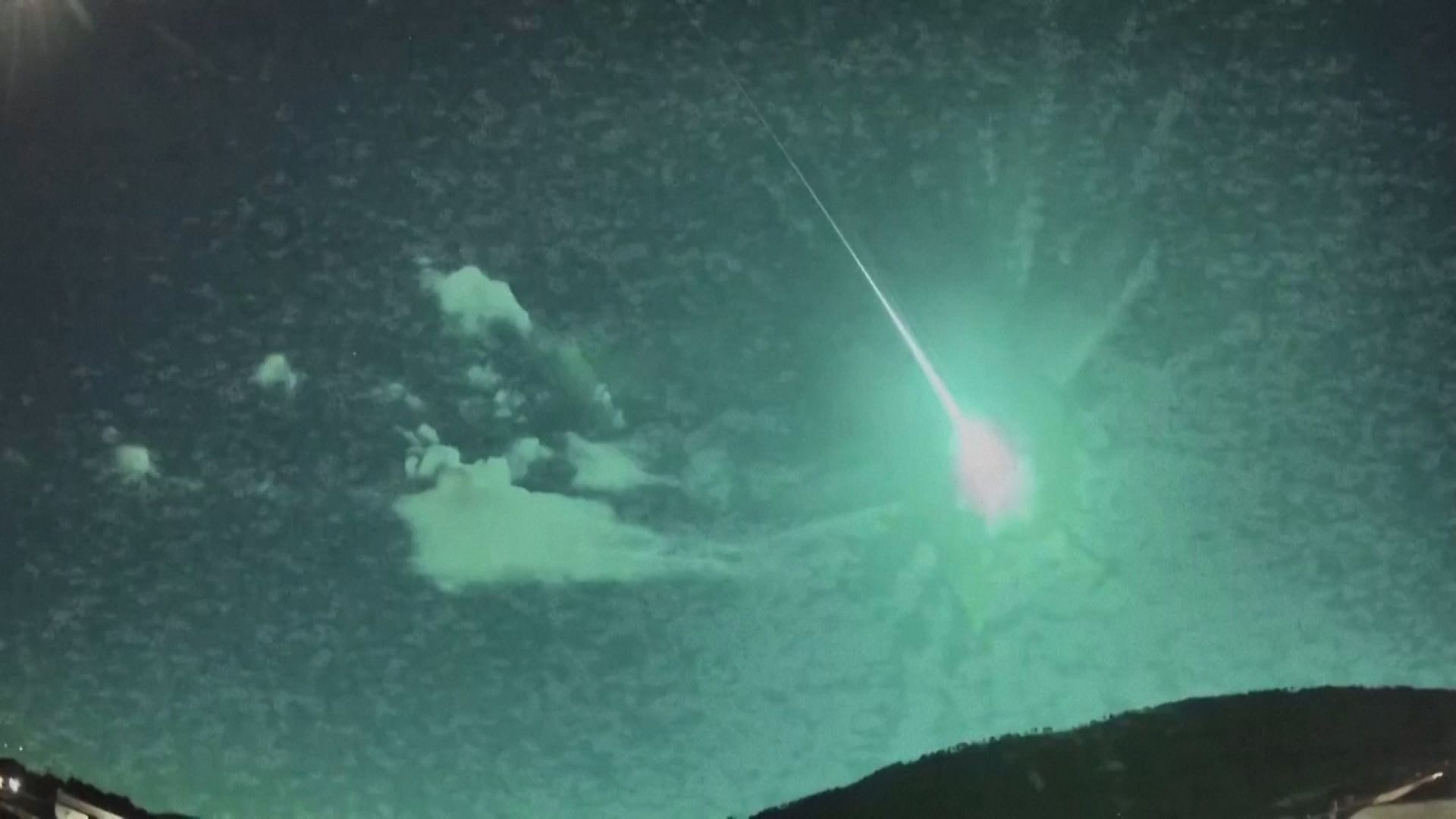

A bright fireball streaked across the skies of Western Europe on Sunday evening (March 8), leaving thousands of people stunned as it illuminated the sky for several seconds.
The spectacular celestial event was witnessed across Belgium, France, Germany, Luxembourg, and the Netherlands.
Observers described seeing a glowing object racing across the sky from southwest to northeast, shining intensely before breaking apart into fragments at approximately 18:55 CET (17:55 UTC). The fireball remained visible for about six seconds, according to early observations.
Videos and photographs of the phenomenon quickly spread across social media, with many people wondering about the nature of the mysterious object.
A meteor just decomposed in front of my eyes in Germany but I have no way to prove it except with this white sky dust#MeteoritDeutschland #Sternschnuppe #meteorit pic.twitter.com/K3RF8Np2cf
— Mourad Ouaz (@mourad_zauo) March 8, 2026
Meteor Cameras Capture the Dramatic Event
The fireball, estimated to be a few metres in diameter, was captured by meteor detection cameras, mobile phones, and security cameras across the region.
Some witnesses also reported hearing audible sounds shortly after the object fragmented in the atmosphere, suggesting pieces may have survived the fiery descent.
According to reports, small fragments believed to be meteorites may have struck a house in Koblenz, a city in western Germany. Authorities said no injuries have been reported so far.
ESA Investigates the Fireball
Following the incident, the European Space Agency (ESA) launched an investigation to determine the nature and size of the object.
Scientists from ESA’s Planetary Defence team, which operates under the Space Safety Programme, are analysing available data from cameras, witnesses and observation networks.
In a statement on its website, the agency said:
“The Planetary Defence team in ESA’s Space Safety Programme is using all available data to estimate the size of the object. They currently assess it to have been up to a few metres in diameter.”
Thousands of Sightings Reported
The spectacular event drew widespread attention across Europe.
According to reports, more than 2,800 sightings were submitted to the International Meteor Organization (IMO) by observers who witnessed the meteor streak across the sky.
Social media platforms were flooded with photos and videos, with one user posting on X that they saw “a meteor just decompose in front of my eyes.”
Is Such an Event Rare?
Although dramatic, such events are not entirely unusual, experts say.
ESA explained that the meteor’s direction and timing likely prevented large telescope surveys from detecting it before it entered Earth’s atmosphere.
Scientists note that only 11 natural space objects have ever been successfully detected before entering Earth’s atmosphere, highlighting the difficulty of spotting smaller bodies approaching from the direction of daylight or twilight.
To improve early detection of such objects, ESA is working on projects like the Flyeye asteroid survey telescope, which aims to enhance the monitoring of near-Earth objects.
Scientists Continue Analysis
Researchers are now studying observational data and potential meteorite fragments to better understand the object’s origin and trajectory.
Events like this provide valuable information for planetary defence programmes that aim to track and monitor near-Earth space objects that could pose potential risks in the future.