


Earth witnessed its most severe ice age around 700 million years ago, leaving behind iconic landforms like moraines, fjords, U-shaped valleys, and glacial lakes. Interestingly, our neighbouring planet Mars carries similar scars of a frozen past — and the European Space Agency (ESA) has now shared compelling visual proof.
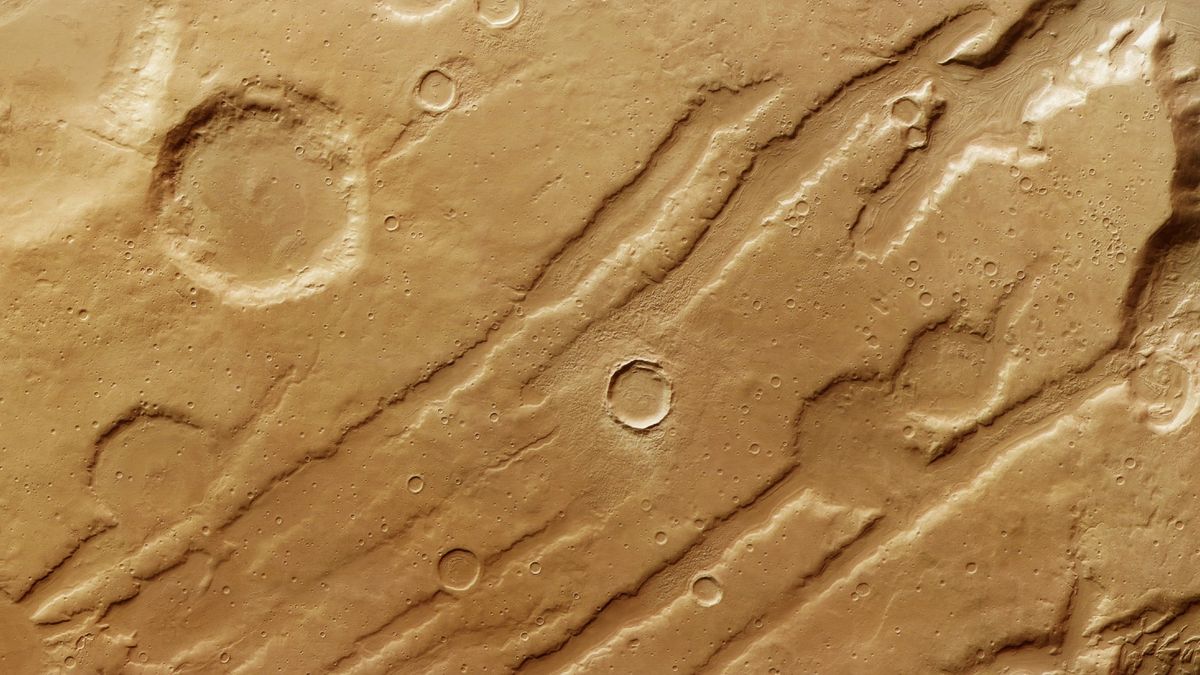
ESA recently released high-resolution images captured by the High Resolution Stereo Camera (HRSC) aboard its Mars Express orbiter, revealing striking glacial formations across the Martian surface. Among the most eye-catching features are the Coloe Fossae, seen as long, parallel fractures slicing diagonally across the terrain — believed to have formed when alternating chunks of Martian ground collapsed over time.
But what truly fascinated scientists were the swirling patterns inside craters and valleys. ESA explained that these formations are remnants of slow-moving icy debris flows, formed during an earlier Martian ice age.
These formations include:
• Lineated Valley Fill (LVF): Valleys filled with ripple-like icy flow patterns.
• Concentric Crater Fill (CCF): Craters featuring layered, ring-like ridges created by ice buildup and movement.
• Lobate Debris Aprons (LDA): Glacier-like ice masses concealed beneath rocky debris.
Surprisingly, these icy traces weren’t found near Mars’ polar caps but at 39° North latitude, far from the freezing north pole — raising a key question: how did ice reach that far?
ESA scientists say the answer lies in Mars’ constantly changing axial tilt. Unlike Earth, Mars experiences extreme shifts in planetary tilt, which dramatically alter its climate over time. During colder phases, glaciers advanced far from the poles toward mid-latitudes, blanketing regions like those seen in the new images. When the climate warmed, the ice retreated but left behind unmistakable geological signatures.
According to ESA, Mars has gone through multiple climate cycles of warming and cooling, much like Earth. The latest major ice age is believed to have occurred as recently as 500,000 years ago, making these formations relatively young in geological terms.
While Mars today appears barren and dusty, these discoveries continue to reshape scientific understanding of its past climate — and may even offer clues about the planet’s potential to have once supported water and life.