

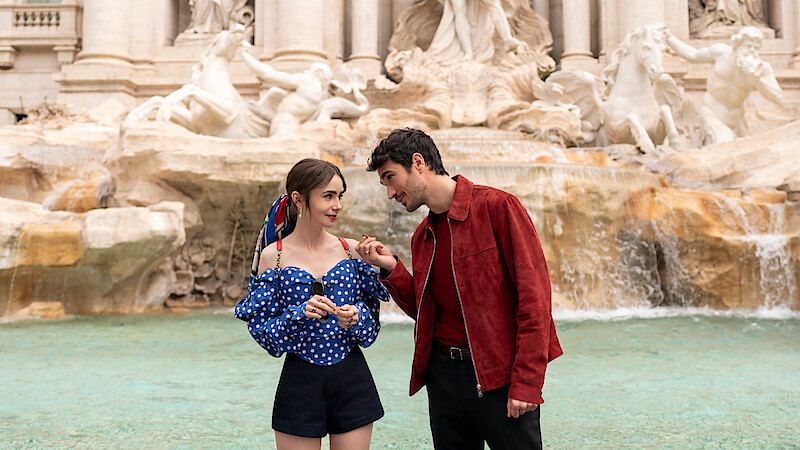

Some shows demand undivided attention; others are designed to play comfortably in the background while you scroll. Emily in Paris has always belonged to the latter category — glossy, noisy comfort television that thrives on fantasy rather than depth. By the time season five arrives, freshly relocated to Rome and armed with yet another reinvention of its eternally optimistic heroine, the series is fully aware of what it is — and what it has no intention of becoming.
The new season opens with a soft reset. Paris, once the show’s beating heart, is gently pushed aside as Emily Cooper (Lily Collins) moves to Rome to lead the Italian outpost of Agence Grateau. The shift is framed as both a professional promotion and a personal fresh start, even if the series’ famously short memory makes it hard to recall why some emotional loose ends existed in the first place.
Emily arrives in Italy with pastel power suits, relentless positivity and the same unshakable belief that every problem — professional or personal — can be solved with the right marketing pitch. Rome, meanwhile, is presented less as a lived-in city and more as a luxury postcard: glowing piazzas, sunlit terraces, reverently filmed pasta plates and enough high-end branding to rival a fashion week front row.
Professionally, Emily now runs the Rome office, tasked with proving that a French firm can hold its own against Italian heavyweights. Sylvie (Philippine Leroy-Beaulieu), still magnetic and formidable, remains both mentor and obstacle, while Luc (Bruno Gouery) and Julien (Samuel Arnold) continue orbiting the chaos with questionable judgment and intermittent competence. Work, as always in Emily in Paris, is not so much labour as performance — meetings double as cocktail parties, clients turn into lovers, and crises exist mainly to facilitate social-media brilliance.
Emily’s greatest asset remains her uncanny ability to stumble into success. Whether pitching luxury brands through personal anecdotes or smearing hamburger meat on her hands to attract a dog owned by a valuable client, solutions arrive more through whimsy than logic.
On the romantic front, season five places Italian businessman Marcello (Eugenio Franceschini) centre stage. Tall, charming and steeped in national stereotypes, Marcello embodies both Emily’s fresh start and her old habits. Their romance unfolds through truffle hunts, family dinners and escalating professional entanglements involving his cashmere empire and imposing mother. Sincere and affectionate — and crucially useful to Emily’s career — Marcello reinforces the show’s long-standing blur between emotional connection and professional advantage.
Gabriel (Lucas Bravo), the lingering emotional complication, refuses to vanish entirely. Despite achieving professional success, his continued presence highlights one of the show’s central frustrations: Emily may change cities, wardrobes and job titles, but her emotional patterns remain stubbornly unchanged.
Mindy (Ashley Park), Emily’s best friend and cheerleader, once again oscillates between ambition and instability. Her arc is packed with romantic chaos, questionable decisions and musical performances that briefly halt the narrative. Whether these moments feel joyful or indulgent depends on one’s tolerance for spectacle over story, but they undeniably reinforce the series’ commitment to excess. Alfie (Lucien Laviscount) also re-enters the orbit, sparking a flirtation that knowingly breaks friendship etiquette before the plot swiftly moves on.
One of the season’s most effective additions is Minnie Driver’s Princess Jane — a cash-strapped influencer who married into Italian royalty and bankrolls her lifestyle through aggressively tacky sponsored content. Her character injects rare moments of self-awareness, acknowledging the absurd, transactional world Emily inhabits. Unfortunately, these flashes are fleeting, quickly swallowed by the show’s broader fantasy.
Thematically, season five treads familiar ground. Everyone dates everyone else, often simultaneously, rarely with lasting consequences. Business and pleasure remain disastrously intertwined, but the series treats this less as a warning and more as a lifestyle choice. Conflicts arise quickly and resolve just as fast, often through misunderstandings that could be fixed with a single conversation. Growth is suggested through haircuts and relocations rather than meaningful emotional change.
Visually, Emily in Paris remains as seductive as ever. The fashion is slightly toned down compared to earlier seasons but still aspirational, with Emily’s wardrobe functioning as both identity and armour. Rome is shot like a luxury brochure, its grit and complexity smoothed away in favour of brand-friendly beauty shots. At times, the show feels less like a narrative and more like an extended advertisement for designer labels, five-star hotels and late-capitalist fantasies of work-life collapse.
And yet, despite its flaws — or perhaps because of them — the series remains compulsively watchable. The episodes are short, the pacing brisk and the stakes intentionally low. Even when the writing feels thin, the performances remain buoyant.
By the end of season five, Emily stands in a familiar place, Roman backdrop notwithstanding. Her life remains unresolved, her choices questionable, her future framed less around who she might become and more around whom she might date next. The season closes not with answers, but with the promise of more of the same — more cities, more outfits, more romantic loops.
Emily in Paris may be running low on narrative innovation, but as long as viewers are willing to switch their brains off and bask in its glossy unreality, it continues to deliver exactly what it promises: a sparkling, shallow escape that knows its own absurdity, even if it rarely dares to confront it. On soupire, on sourit, et on regarde quand même. We sigh, we smile, and we watch anyway.