

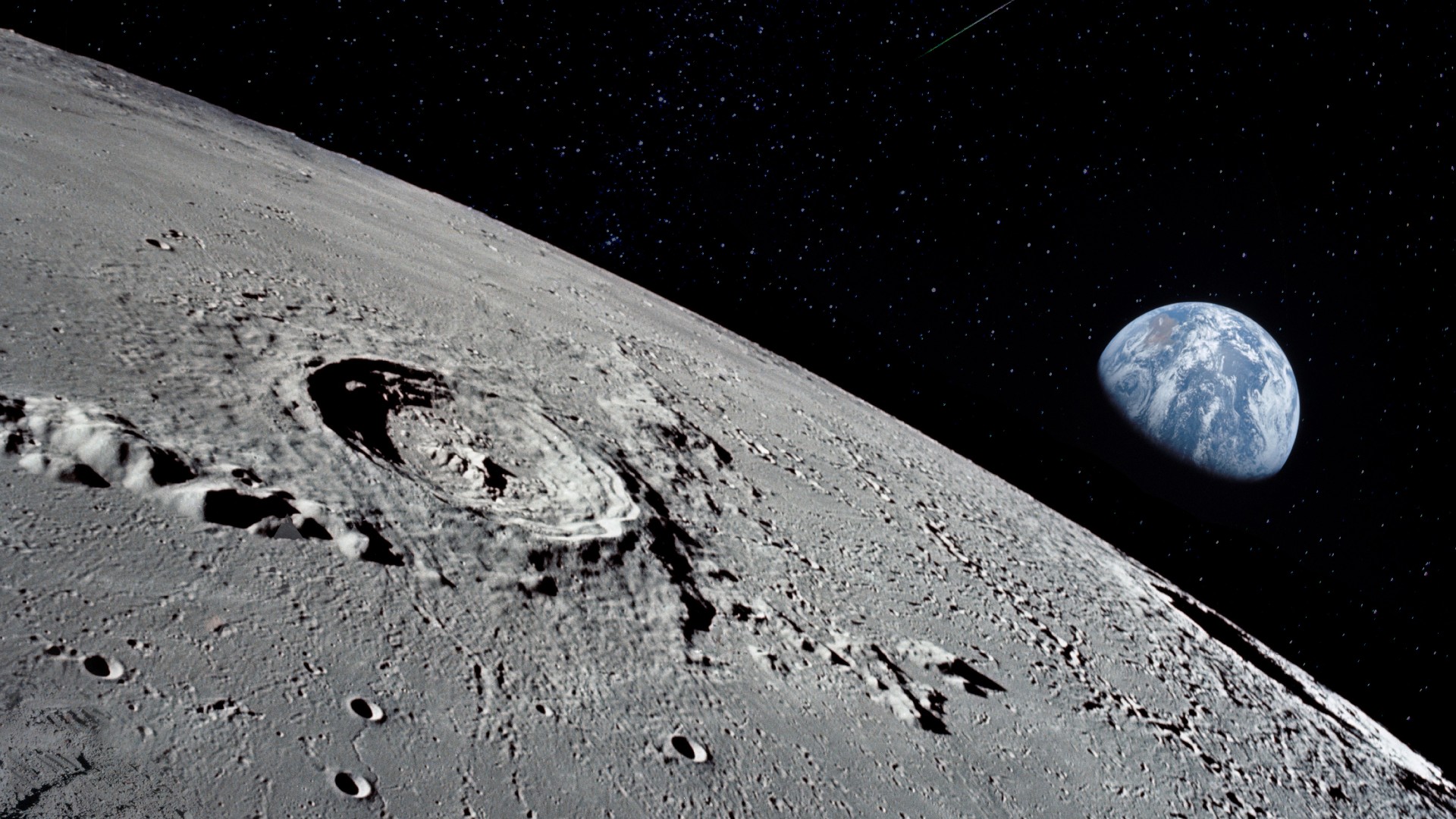

Scientists have discovered a surprising and profound connection between Earth and the Moon, revealing that our planet may have played a far greater role in shaping the lunar environment than previously believed. According to new research reported by Science Daily, Earth’s magnetic field has been quietly supplying essential elements to the Moon for billions of years — effectively “nourishing” the lunar surface.
Though the Moon appears barren and lifeless, microscopic fragments from Earth are believed to have reached its surface and become embedded in lunar soil. Researchers suggest that one day these materials could even help future human missions survive on the Moon.
The study, published in Nature Communications Earth and Environment, was conducted by scientists at the University of Rochester. Their findings show that Earth’s atmosphere has actually helped transfer these particles to the Moon instead of blocking them, as previously assumed.
Eric Blackman, professor in the Department of Physics and Astronomy and researcher at Rochester’s Laboratory for Laser Energetics, explained that by combining preserved lunar particles with advanced models of solar wind interaction, researchers were able to reconstruct the history of Earth’s magnetic field and atmosphere over billions of years.
This long-running process has essentially turned lunar soil into a massive archive — a preserved record of Earth’s ancient atmospheric composition.
Researchers analysed Moon rocks and soil samples collected during NASA’s Apollo missions in the 1970s. They detected traces of elements including water, carbon dioxide, helium, argon, and nitrogen on the Moon’s surface. While some of these materials came from solar wind, the quantity of nitrogen and other elements indicates that Earth must have contributed significantly.
Earlier theories claimed the particles could only have reached the Moon before Earth developed its protective magnetic field, arguing the field would block atmospheric escape. However, the latest study, using advanced simulations, proves otherwise — showing that Earth’s magnetic shield actually helped channel these particles toward the Moon.
The researchers say the discovery not only reshapes our understanding of the Moon’s history but also has major implications for studying other planets. Co-author Paramanick noted that this finding could help explain atmospheric evolution on Mars, which once had a magnetic field and thick atmosphere similar to Earth’s but eventually lost both.
By studying how planetary atmospheres escape and interact with magnetic fields over time, scientists hope to learn more about planetary habitability — and what makes worlds capable of supporting life.