

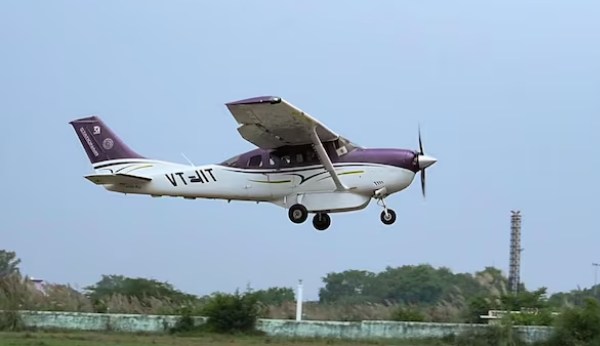

A highly anticipated and expensive attempt to utilize cloud seeding to make fake rain over Delhi failed on Tuesday. The Bharatiya Janata Party (BJP)-led administration worked with IIT Kanpur on the trial, which was meant to get rid of the thick pollution that was making the city’s air quality “very poor.”
Trials that cost a lot of money don’t bring rain.
The Delhi Cabinet first agreed on the cloud seeding project on May 7. They set out ₹3.21 crore for five trials, which works out to about ₹64 lakh each trial.
The test used a small Cessna plane with only one propeller on Tuesday. It hovered over areas of Northwest Delhi and the National Capital Region (NCR) and fired silver iodide flares in two different cloud seeding attempts. The two trials that took place on Tuesday cost about ₹1.28 crore in total.
Even though a lot of money was spent, the trials did not cause any measurable rainfall in the area. Delhi’s environment minister, Manjinder Singh Sirsa, nonetheless called the attempt “successful,” though.
Information about the Cloud Seeding Experiment
The Cessna plane shot 16 flares—eight in each trial—into the clouds. The flares contained chemicals including silver iodide and sodium chloride.
The first trial, which ended by 2 p.m., targeted Burari and the neighboring districts, Mayur Vihar, and Noida. Later in the day, a second experiment took place in regions outside of Delhi, such as Badli.
Minister Sirsa said before that “Delhi has taken an unprecedented, science-first step by adopting cloud seeding as a tool to control air pollution.” We want to find out how much rain can fall when the humidity is like it is in Delhi.
But an official report from the Delhi government on the trials gave a big reason for the absence of rain: the IMD anticipated that the moisture content would be low, only 10–15 percent, which is not good for cloud seeding. The official study said that the trials did assist lower the amount of particulate matter in the exact places where they were carried out, even though they did not cause rain.
Political Fight Breaks Out Over Failure
The failed attempt rapidly became a political flashpoint, especially with the Aam Aadmi Party (AAP), which was in charge of the previous government, denouncing the move.
Saurabh Bharadwaj, the leader of the AAP, held a press conference to make fun of the BJP-led administration and challenge their choice to hold trials on a day when the IMD had already predicted rain. Bharadwaj held up signs accusing the government of “frauds” while the Bollywood song “jhooth bole kauwa kaate” played in the background. He then asked, “Will Lord Indra come down to clarify whether it is artificial rain or natural rain?”
The concept to seed clouds wasn’t new; the AAP government had suggested it in the winter of 2023 but couldn’t move forward because of bad weather and the fact that they didn’t have the necessary aviation and environmental permits from the BJP-led central government. Minister Sirsa has already criticized AAP for “only talking about such plans” and not doing anything about them.
Sirsa first said that IIT-Kanpur thought it could rain 15 minutes to four hours after the exercise, but he warned that the rain wouldn’t be heavy because the humidity was just 15 to 20 percent. Still, IMD statistics showed that there was no rain in Delhi till late at night.