

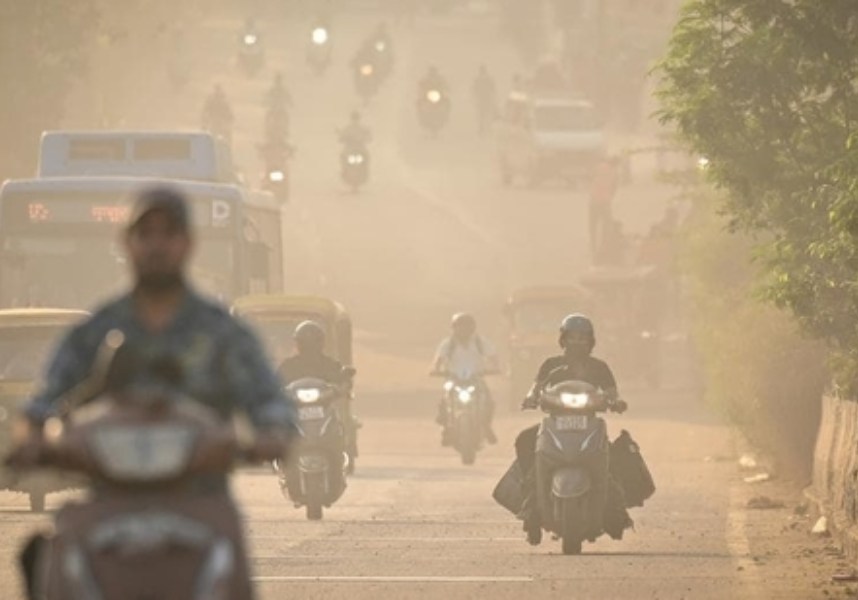

Delhi woke up to a choking Friday morning as the city’s air quality sharply deteriorated, with the Air Quality Index (AQI) touching 301, falling in the ‘very poor’ category, according to the Central Pollution Control Board (CPCB).
High concentrations of dust blown in from Rajasthan, propelled by strong winds sweeping through Palam and surrounding areas, were cited as the major cause of the sudden spike in pollution. The India Meteorological Department (IMD) said gusty winds reaching 30-40 km/h carried particulate matter into the capital, worsening the city’s air even in the month of May — a period when such deterioration is rare.
At 7 a.m., Delhi’s overall AQI stood at 301, with many monitoring stations recording levels far higher:
- Anand Vihar: 352
- Ashok Vihar: 322
- Aya Nagar: 333
The IMD noted that the dust incursion from western regions is expected to persist for another 24-48 hours, potentially prolonging the air quality crisis.
Political Blame Game Escalates
The deteriorating air quality triggered a fresh political war in Delhi. The Aam Aadmi Party (AAP) launched a scathing attack on the BJP, accusing it of failing to control pollution despite holding power in Delhi’s administration since February.
On social media platform X, AAP’s official handle stated:
“In May itself, AQI has crossed 500 in many areas of Delhi-NCR. Poisonous dust is in the air. This has never happened before. BJP governments in Delhi and neighboring states have done nothing to tackle pollution.”
AAP National Convenor Arvind Kejriwal also weighed in, sharing a news report on the worsening AQI and writing:
“Air pollution was never this bad during the AAP regime at this time of year.”
In response, Delhi Minister Manjinder Singh Sirsa slammed former CM Atishi for politicizing the weather event.
“Atishi has been the CM and she tweets like this? The weather department predicted storms and dust, but now we’ll be blamed for that too?” he asked, sarcastically adding:
“But we accept the challenge. The ‘disease’ that AAP-da has spread over the last 10 years — we are working to cure it.”
Health Concerns Rise
Experts have warned that PM10 and PM2.5 particles from the dust storm are dangerous for asthmatics, the elderly, and children. Authorities have advised residents to avoid outdoor activities, wear N95 masks, and use air purifiers indoors if possible.
With the pollution crisis worsening unexpectedly in summer, Delhi’s fragile air quality situation has once again become a flashpoint for public health and political accountability.