

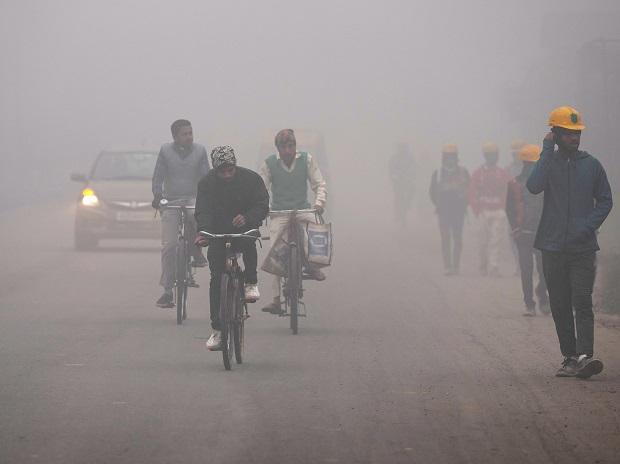

New Delhi woke up to yet another day of smog and toxic air on Tuesday, marking the fifth consecutive day the city’s air quality has remained in the ‘Very Poor’ category. The overall Air Quality Index (AQI) was recorded at 341 at 6 am.
This reading shows a slight improvement from the previous days (Monday’s 359 and Sunday’s 377), an improvement credited to an increase in wind speed, which reached 15 km/hr on Sunday. Despite this marginal relief, the air across the national capital and its adjoining areas remains toxic to breathe.
Cold and Severe Pollution Pockets
The pollution crisis is unfolding amidst a sharp drop in temperature. Delhi is feeling the winter chill, with the minimum temperature on Monday dropping to 8.7∘C—four notches below the seasonal normal. This marks the lowest minimum temperature for November since 2022, when it registered 8.3∘C on November 30.
While the city average saw a slight dip, several areas continued to record alarming levels in the ‘Severe’ category (AQI above 400), according to the Central Pollution Control Board’s (CPCB) Sameer app: Bawana stood at 419, Jahangirpuri at 414, and Wazirpur at 410 by 6 am on Tuesday.
Forecasting models from the Early Warning System (EWS) under the Ministry of Earth Sciences (MoES) indicate that the current relief is temporary. The air quality is expected to deteriorate again and touch the ‘Severe’ zone until Wednesday. The forecast suggests Delhi’s air quality will likely remain in the ‘Very Poor’ category through November 20.
Stage 3 measures of the Graded Response Action Plan (GRAP) have been in effect in Delhi since November 11, when the air quality initially slipped into the “severe” category with an AQI of 428.
Ghaziabad Tops National Pollution Chart
In the National Capital Region (NCR), Ghaziabad recorded the highest pollution level in the country on Monday, becoming the only city to record a “severe” AQI of 401, with PM2.5 identified as the primary pollutant. Specific locations like Loni (414) and Sanjay Nagar (433) also recorded ‘Severe’ readings, with officials noting that Monday marked Ghaziabad’s first “severe” air day in 2025.
Supreme Court Rejects Sweeping Curbs
In a significant judicial decision on Monday, the Supreme Court of India declined to impose stringent, year-round pollution-control measures across Delhi-NCR. Petitioners had urged for drastic steps like a year-round construction ban or blanket limits on vehicular movement, arguing that the Capital had become a “gas chamber.”
A bench led by Chief Justice of India Bhushan R. Gavai observed that the Capital “cannot be brought to a standstill” to combat the toxic air.
The CJI stated, “We cannot bring everything to a standstill… There cannot be a complete stoppage of all activities.” The bench also emphasized the socio-economic cost, noting they “have to also think of migrants from Bihar and Uttar Pradesh who are here to work and are daily wagers. The solution proposed cannot be worse than the problem.”