

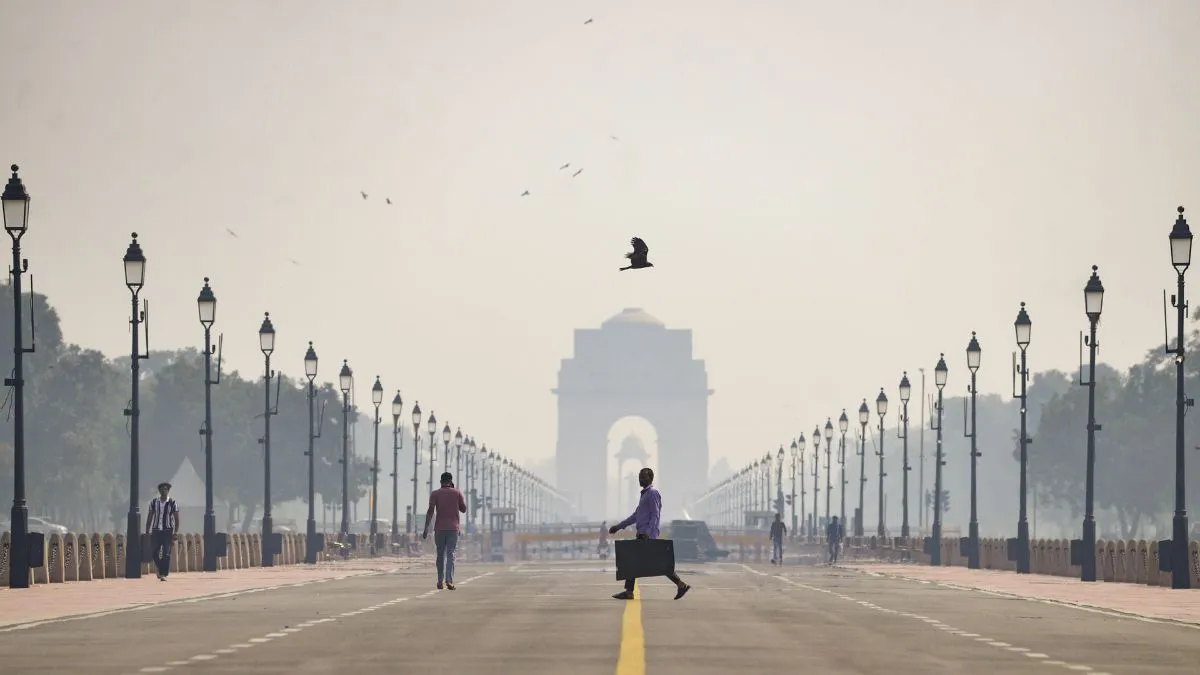

The air quality in the national capital continued its worrying slide into the ‘Poor’ category on Sunday morning, with the Air Quality Index (AQI) hitting 284 near ITO, according to data released by the Central Pollution Control Board (CPCB).
The CPCB classifies an AQI between 201 and 300 as “poor,” which is known to cause breathing discomfort to most people on prolonged exposure. While the India Meteorological Department (IMD) forecasts a clear sky with maximum temperatures around $33^\circ\text{C}$ for the day, the stagnant air quality remains a major concern for residents, particularly those engaged in outdoor activities.
Local Residents Suffer
The deteriorating air has directly impacted the health and daily routine of Delhiites. Aryan Gupta, a local cyclist, expressed the difficulties he and others face.
“Just like every year, pollution in Delhi persists…It causes difficulty in breathing, especially to cyclists like me,” Gupta said. The local from Rohini, who regularly cycles long distances, noted the irritation in his eyes and the added difficulty in breathing due to his sinus condition. “Closing of schools and colleges are temporary solutions,” he added, highlighting the need for permanent fixes.
Focus Shifts from Firecrackers to Core Causes
Gupta also weighed in on the sources of pollution, emphasizing that while firecrackers contribute, they are not the primary culprits.
“The major contributors are not firecrackers, but the vehicle emissions and crop burning,” he stated. He pointed out that Delhi’s landlocked geography causes it to collect pollution from neighboring states like Punjab, Haryana, and Uttar Pradesh. Gupta suggested long-term technological interventions such as installing smoke towers and creating artificial rain to effectively tackle the region’s air quality crisis.
As the capital approaches the festive season, the cumulative effect of crop residue burning, vehicular exhaust, and impending firecracker use is expected to keep the air quality under severe strain.