

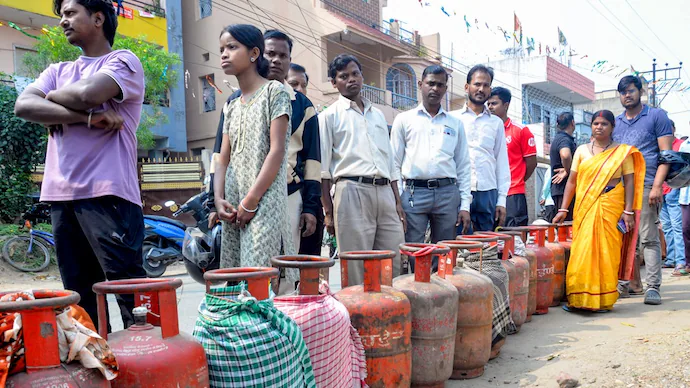

NEW DELHI — A wave of anxiety swept through the national capital on Tuesday, March 10, 2026, as residents scrambled to secure cooking gas cylinders following the central government’s decision to invoke the Essential Commodities Act. The emergency measure, triggered by the near-total shutdown of the Strait of Hormuz amid the escalating U.S.-Israel-Iran conflict, aims to prioritize domestic households over industrial users, but it has inadvertently triggered a localized “rush” at gas agencies.
1. The “25-Day Rule” and Delivery Stalls
To curb hoarding and panic buying, the Ministry of Petroleum and Natural Gas has implemented a mandatory 25-day minimum gap between domestic cylinder bookings (up from the previous 21-day window).
- System Stalls: Agencies in Central Delhi, including those near Jhandewalan, reported that the automated booking system is now rejecting slips for customers who booked just a few days ago, leading to heated exchanges at distribution points.
- Supply Gaps: While the government insists there is no national shortage, local stockouts are appearing. Agencies in Kirti Nagar (West Delhi) reported receiving zero shipments on Tuesday, despite usually getting over 350 cylinders daily from regional suppliers.
2. Restaurants and Commercial Crisis
The hospitality sector in Delhi-NCR is bearing the brunt of the rationing.
- Commercial Suspension: Following government directives, many agencies have completely stopped delivering 19kg commercial cylinders to non-essential businesses.
- Limited Menus: In Connaught Place, several high-end restaurants have begun scaling back menus, as piped natural gas (PNG) is not available in many heritage blocks and backup cylinders are drying up.
- Black Market Surge: Despite official price caps, reports have surfaced of cylinders being sold for as much as ₹2,000 in the black market—nearly double the official rate of ₹913 (for 14.2kg domestic).
3. Essential Commodities Act (EC Act) Explained
By invoking the 1955 Act, the government has gained sweeping powers to control the supply chain:
- Priority Allocation: 100% of available gas is being diverted to Piped Natural Gas (PNG) for homes, CNG for transport, and LPG for domestic use.
- Industrial Cuts: Petrochemical plants and refineries have been ordered to cut their own gas use by up to 35% to feed the public pool.
- Inventory Monitoring: Agencies must now report stocks daily to prevent hoarding under the threat of seizure and prosecution.
Delhi LPG Status: March 11, 2026
| Category | Status | Current Rate (Delhi) |
| Domestic (14.2kg) | Strictly Rationed | ₹913.00 (Up from ₹853) |
| Commercial (19kg) | Supply Suspended | ₹1,884.50 (Market Rate) |
| Booking Interval | 25 Days | (Strictly enforced) |
| Piped Gas (PNG) | Stable | (High Priority) |