

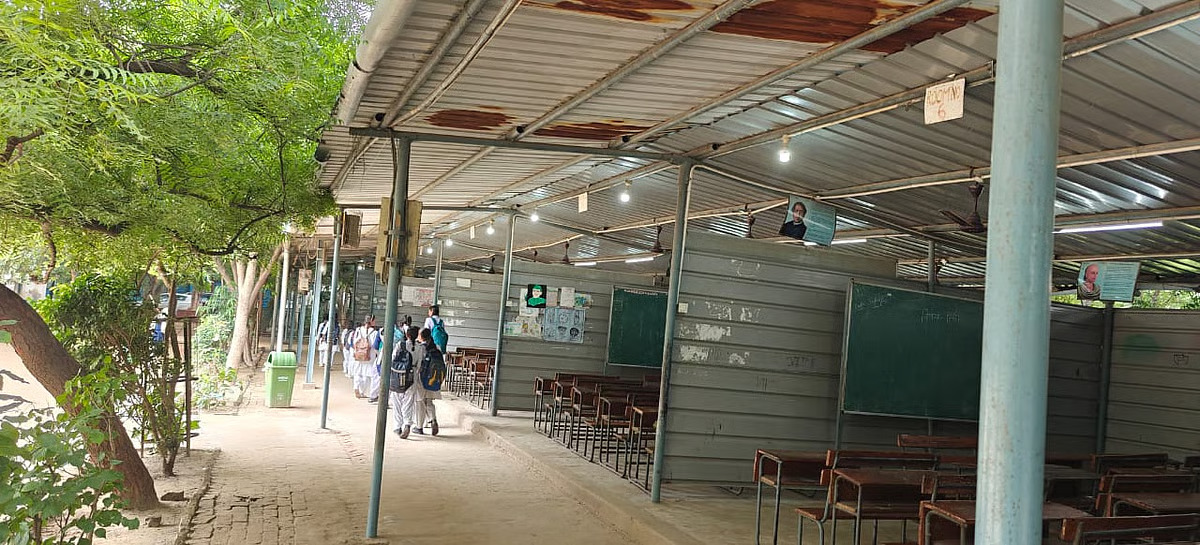

NEW DELHI — Government schools in the national capital are still having a lot of trouble with their infrastructure. Students have to go to class in tin shelters during the hot summer, heavy monsoon rains, and freezing winter. The Delhi High Court has strongly criticized this worrying condition, saying that it is still not getting the right facilities.
Reports say that at least six schools in Delhi are working under these bad conditions. The Delhi High Court, in particular, talked about how bad things were for three of these schools. They said, “We are in 2025, and the Delhi government is still running schools in tin sheds.” How can these schools possibly compete with private schools? It is not safe or right to learn in a place like this. “Children’s safety and education are both at risk.”
Ashok Agarwal, an activist for education, has taken up the cause of the other three schools that were affected and contacted the Directorate of Education to talk about it. These schools are Sarvodaya Kanya Vidyalaya (Zeenat Mahal, Kamla Market), Government Girls Secondary School, and Government Boys Secondary School in Ashok Nagar. Together, they have about 1,500 pupils. When NDTV went to the Kamla Market school, the staff said that about 500 primary school pupils were learning in tin shelters. They said that a solution was on the way and that they planned to turn the current practical rooms into permanent classrooms for these children.
Ashish Sood, the Delhi Education Minister, said that the current status is due to years of negligence. “Six months isn’t enough time to remedy this. He remarked, “This is the result of 27 years of neglect.” “We are slowly making things better, but those who promised a ‘education revolution’ should also answer these questions.”
The High Court has dealt with the problem of poor government school infrastructure before. In 2024, the court told the Directorate of Education to make sure that desks, uniforms, and books were available in a certain amount of time. Activists are worried again because the situation hasn’t altered much.
Mr. Agarwal, a strong supporter of education, thinks that politicians and officials often ignore government schools since their own kids go to pricey private schools. “This goes against the Constitution. You need to provide these kids a good education if you want your country to be powerful. He said, “Sadly, governments don’t get this simple truth.” He remembered having similar problems in the 1980s and 1990s, when pictures of schools running under tents would get people in trouble in court. He was shocked that these kinds of things still happen in Delhi today.