

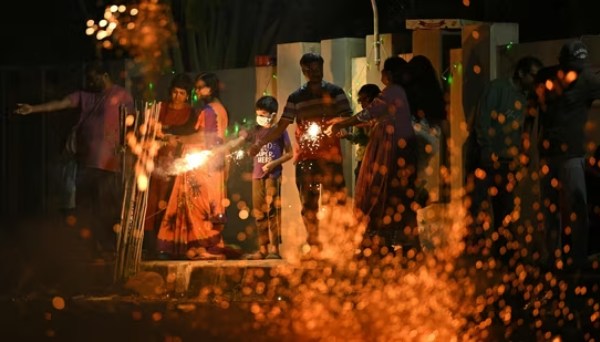

Delhi Fire Services handles 269 emergency calls on Diwali with no major casualties, but air quality plunges to an AQI of 350 in the ‘Very Poor’ category, with several areas hitting ‘Severe’ status due to firecrackers and pollution.
The Delhi Fire Services (DFS) remained on high alert during the Diwali festival, successfully managing 269 emergency calls received on Diwali night, while no major incidents or casualties were recorded.
A senior DFS officer told news agency PTI that all fire stations and quick response teams were deployed across the city to ensure public safety. “We received 269 fire calls till midnight. Fortunately, no major incidents were reported,” the officer stated.
Most of the emergency calls were related to minor blazes sparked by firecrackers and diyas (earthen lamps). The department had previously cancelled all staff leaves and thoroughly checked all firefighting equipment to ensure prompt response capability, noting that the detailed planning was crucial. Last year, the DFS had received just over 200 calls on Diwali night.
Post-Diwali Smog: Air Quality Hits ‘Very Poor’ and ‘Severe’ Categories
While the city avoided major fire tragedies, it woke up on Tuesday to a thick, heavy layer of smog as the air quality sharply deteriorated. The air quality index (AQI) across the National Capital Region (NCR) fell into the ‘Very Poor’ category, with most monitoring stations recording pollution levels in the ‘red zone’.
According to the Central Pollution Control Board (CPCB), the total AQI in Delhi stood at 350 as of 8 am.
Worst-Hit Areas
Several areas in Delhi recorded AQI figures that fall under the ‘Severe’ category, where air quality affects even healthy people and seriously impacts those with existing diseases, as per CPCB standards. The worst-hit areas included:
Bawana: AQI of 423
Jahangirpuri: AQI of 407
Wazirpur: AQI of 408
Other Affected Areas (AQI at 8 am)
Other important places where the air quality was rated as “Very Poor” were:
Ashok Vihar: 389
Punjabi Bagh: 376
Mundka: 366
Anand Vihar: 358
Narela: 358
Chandani Chowk: 350
ITO: 342
Lodhi Road: 322
IGI Airport (Terminal 3): 302
The CPCB says that when the air quality is “very poor,” people may have trouble breathing and be more likely to have respiratory infections if they are exposed to it for a long time.
Meanwhile, other major Indian cities also witnessed increasing pollution levels. Mumbai was in the ‘poor’ category with an AQI of 214, Patna at 224, Jaipur at 231, and Lucknow at 222. Southern metros fared marginally better, with Bengaluru recording an AQI of 94 and Hyderabad at 107.