

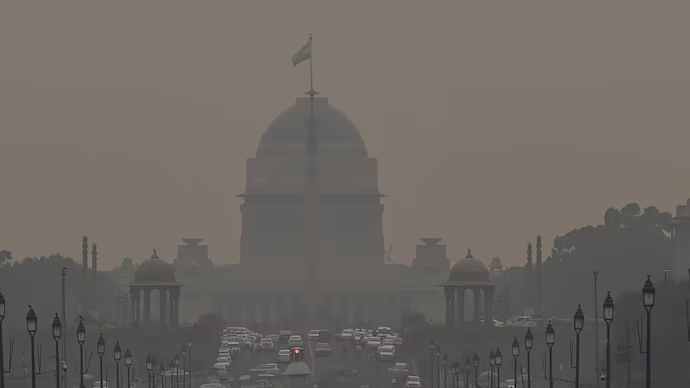

The air quality in the national capital has taken a turn for the worse, with pollution levels soaring and several parts of the city registering in the ‘severe’ category on Saturday. The 24-hour average Air Quality Index (AQI), as reported by the Central Pollution Control Board (CPCB) at 4 pm, stood at 361—placing Delhi in the ‘red zone’ (‘Very Poor’) and making it the second most polluted city in the country for the day.
Key Areas Hit ‘Severe’ Levels
The alarming spike saw several individual monitoring stations recording AQI figures over 400, indicating ‘Severe’ air quality, where the air poses a risk of respiratory illness even to healthy individuals.
| Monitoring Station | AQI Recorded (Approx. 4 pm) | Category |
| Wazirpur | 420 | Severe |
| Burari | 418 | Severe |
| Vivek Vihar | 411 | Severe |
| Nehru Nagar | 406 | Severe |
| Alipur | 404 | Severe |
| ITO | 402 | Severe |
Pollutants and Contributing Factors
PM2.5 and PM10 remained the key pollutants dominating the air on Saturday. The Decision Support System (DSS) for air quality forecasting indicates that multiple external factors are driving the pollution spike:
- Stubble Burning: Stubble burning incidents contributed around 30% to Delhi’s pollution on Sunday, with satellite data showing 100 incidents in Punjab and 164 in Uttar Pradesh on Friday alone.
- Transport Sector: Vehicular emissions accounted for 15.2% of the pollution load on Sunday.
The situation in the National Capital Region (NCR) remains ‘Very Poor,’ with Noida recording an AQI of 354, Greater Noida 336, and Ghaziabad 339.
Outlook Remains Bleak
Since Diwali, the national capital’s air quality has consistently remained in the ‘Poor’ or ‘Very Poor’ categories, with frequent slips into the ‘Severe’ zone.
The Air Quality Early Warning System for Delhi has predicted that the city’s air quality will remain in the ‘Very Poor’ category over the next few days, urging residents to take necessary precautions.