

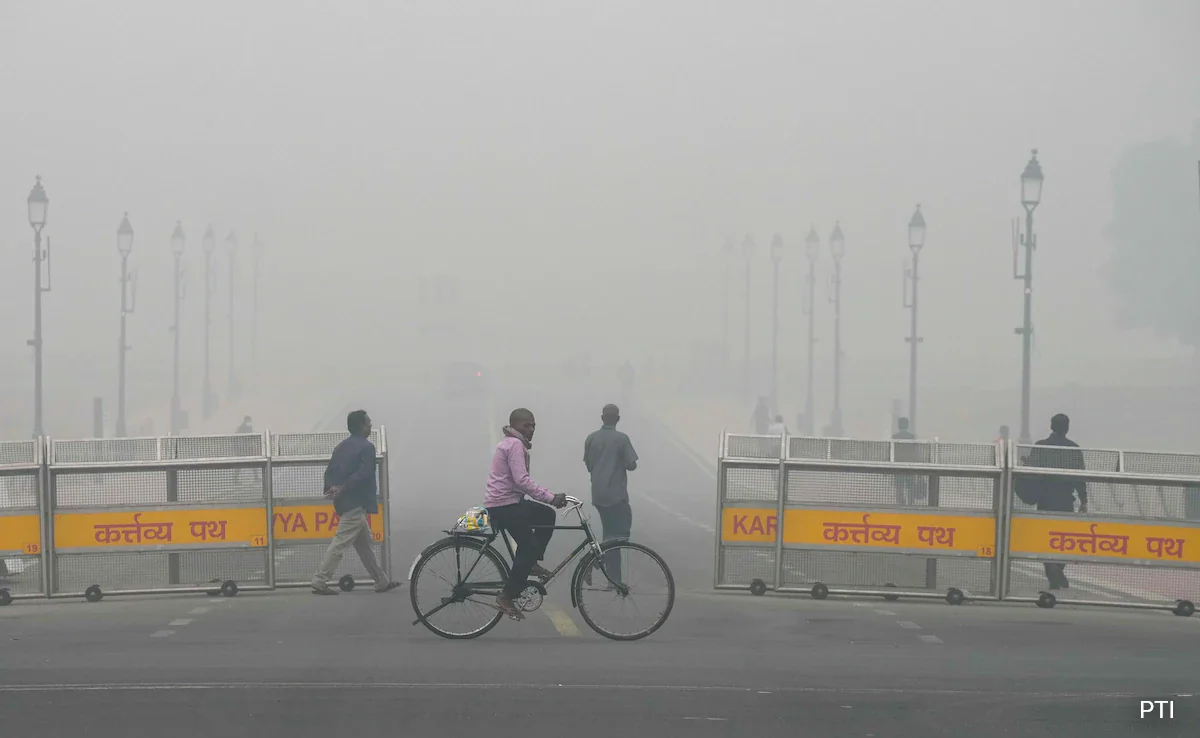

Delhi witnessed another severe deterioration in air quality on Wednesday morning, with a sharp drop in visibility and a haze-obscured skyline as the city’s Air Quality Index (AQI) touched 340 at around 7:15 a.m., placing it firmly in the “hazardous” category.
According to data from the AQI monitoring website, PM2.5 concentration stood at 243 micrograms per cubic metre, while PM10 levels were recorded at 337 micrograms per cubic metre. PM2.5 particles are fine inhalable pollutants capable of penetrating deep into the lungs, while PM10 includes slightly larger particles that also pose serious health risks.
Health advisories based on AQI data suggest that breathing Delhi’s air under these conditions is equivalent to smoking about 8.6 cigarettes a day, underlining the severity of the pollution episode.
The Decision Support System (DSS) for Air Quality Management in Delhi identified transport emissions as the largest contributor to pollution at 3.079%, followed by construction activities at 1.732% and stubble burning at 0.218%. Unfavourable meteorological conditions have further aggravated the situation by trapping pollutants close to the ground.
In response to the sharp rise in pollution levels since Saturday, the Commission for Air Quality Management (CAQM) has invoked Stage IV of the Graded Response Action Plan (GRAP), the strictest set of emergency measures to curb air pollution in Delhi-NCR.
Under Stage IV restrictions, all construction and demolition activities have been completely banned across the region, including linear public projects such as highways, flyovers, roads, power transmission lines, pipelines and telecom works, which are otherwise permitted during lower GRAP stages.
The entry of trucks into Delhi has been stopped, except for those carrying essential commodities or providing essential services. CNG, LNG, electric and BS-VI diesel trucks, however, are allowed. Additionally, the plying of Delhi-registered diesel heavy goods vehicles that are BS-IV and below has been prohibited, with exemptions only for essential services.
Educational institutions have also been affected. Schools in Delhi and the most impacted NCR districts have been directed to operate in a hybrid mode for all classes, including Classes VI to IX and XI, allowing students the option of attending online classes wherever feasible.
State governments have been advised to remain prepared to implement further emergency steps if pollution worsens, including shutting colleges and other educational institutions, closing non-essential commercial activities and even introducing odd-even vehicle restrictions.
Every winter, Delhi-NCR enforces curbs under GRAP, which categorises air quality into four stages: Stage I (Poor, AQI 201–300), Stage II (Very Poor, AQI 301–400), Stage III (Severe, AQI 401–450) and Stage IV (Severe Plus, AQI above 450). A combination of vehicle emissions, paddy-straw burning, firecrackers and local pollution sources, along with adverse weather conditions, typically pushes air quality to dangerous levels during this period.