

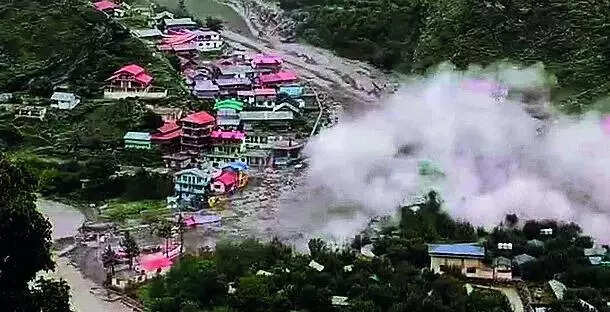

Experts are coming to the conclusion that a glacial lake outburst flood (GLOF) rather than a cloudburst triggered the wall of muddy water and debris that tore through the Indian Himalayan village of Dharali this week, leaving many people missing and at least four dead. Scientists say that this phenomenon is connected to the faster melting of Himalayan glaciers, which is a direct result of climate change.
A Cloudburst or a Glacier Catastrophe?
At first, government officials said that the flash flood was caused by a strong “cloudburst” of rain. However, glaciologists and Himalayan hazard experts who have been looking into the occurrence currently think that a “glacio-fluvial debris landslide” was probably the main cause, even though heavy rain may have played a role.
P.K. Joshi, a Himalayan hazards expert at Jawaharlal Nehru University, says that the flood seems to have been caused by the collapse of a “moraine-dammed lake.” A moraine is a pile of boulders, soil, and silt that a glacier leaves behind as it moves back. When glaciers melt, the meltwater can pool behind these unstable moraine deposits and make a lake. If this natural barrier had suddenly broken, a huge amount of water and debris would have been unleashed, causing the “sudden high energy flash flood” that was seen.
What Climate Change Does
Experts say that the quantity of rain that fell right before the flood wasn’t enough on its own to explain the huge amount of water and debris that swept across the valley. This suggests that the source was a lake that was collapsing, probably because of more rain and melting snow.
Because of climate change, Himalayan glaciers are melting faster than ever before. These glaciers are a major source of water for about two billion people. This faster melting not only makes these glacial lakes that could be unstable, but it also makes the permafrost softer, which makes landslides more likely.
A Situation Getting Worse Because of People
Both Safi Ahsan Rizvi, an adviser to the National Disaster Management Authority, and Sandip Tanu Mandal, a glaciologist at New Delhi’s Mobius Foundation, agreed with the idea of a GLOF. They say that the disaster “highlights the complex and interconnected nature of Himalayan hazards” and that “land use patterns” and rapid, uncontrolled building in the floodplain downstream of the incident certainly made the devastation worse. The calamity serves as a sobering reminder of the risks residents confront in this ecologically vulnerable region, as the exact source of the debris is still hidden by clouds and satellite images are needed to confirm it.