

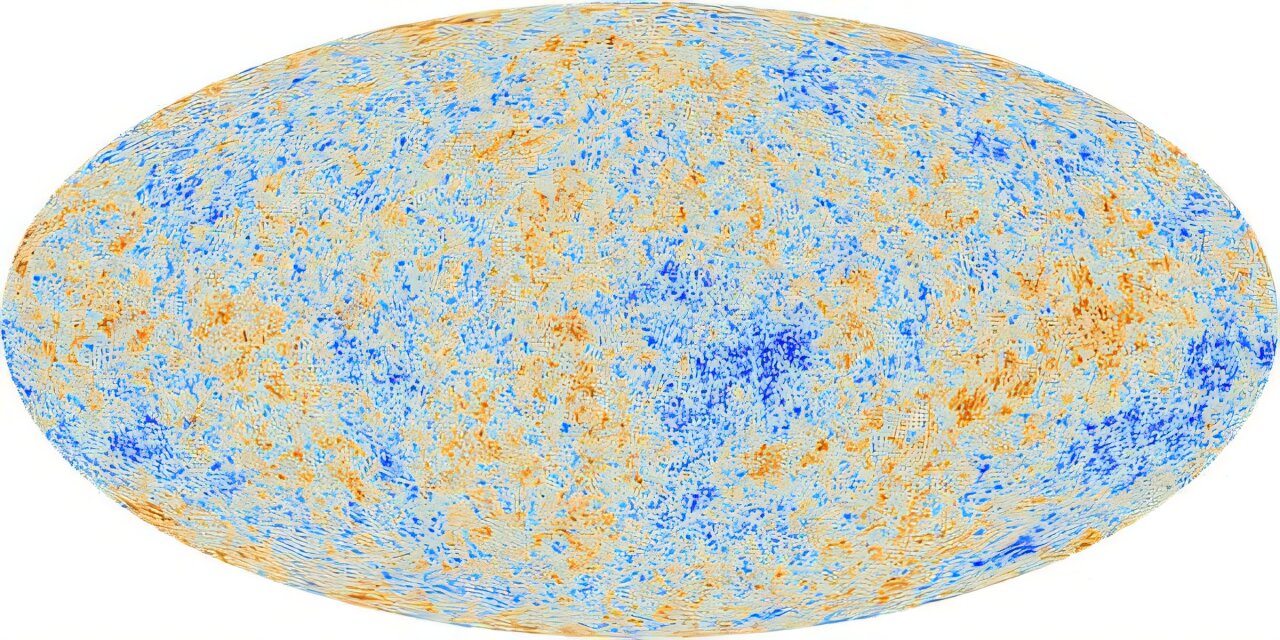

A new scientific study has proposed that the universe may not be uniform in all directions, challenging one of the most fundamental assumptions of modern cosmology. The findings suggest that observed temperature variations in the cosmic microwave background (CMB) — known as the cosmic dipole anomaly — cannot be fully explained by fluctuations in distant astronomical sources such as radio galaxies and quasars.
This conclusion implies that the universe may be anisotropic and potentially asymmetrical or lopsided, a possibility that would require a significant revision of the widely accepted Lambda-Cold Dark Matter (ΛCDM) model, which assumes a homogeneous and isotropic universe on large scales.
What Is the Cosmic Dipole Anomaly?
According to a report published in The Conversation, researchers examined the cosmic dipole anomaly using the Ellis-Baldwin test, a method designed to assess large-scale cosmic motion and structure. Earlier studies had already hinted at inconsistencies, noting that the distribution of matter across the sky appears orthogonal to the CMB dipole — a result that contradicts predictions of the standard cosmological model.
Multiple independent observations, including data from radio surveys and mid-infrared measurements, support the presence of this discrepancy. The consistency across different datasets makes it increasingly difficult to attribute the anomaly to measurement errors or observational bias, strengthening the case that the effect is real.
Implications for the Standard Model of the Universe
These findings pose a direct challenge to the Friedmann–Lemaître–Robertson–Walker (FLRW) framework, which underpins modern cosmology and assumes that the universe is both isotropic and homogeneous on large scales.
Scientists suggest that resolving the anomaly may require new models of cosmic structure, potentially incorporating machine-learning techniques to uncover patterns that traditional methods might miss. The anomaly serves as a reminder that even long-held assumptions about the universe’s symmetry could be incomplete or overly simplistic.
Future Telescopes May Unlock the Mystery
Upcoming and next-generation observatories are expected to play a crucial role in addressing these unanswered questions. Space missions such as Euclid and SPHEREx, along with ground-based facilities like the Vera C. Rubin Observatory and the Square Kilometre Array (SKA), are poised to deliver far more precise cosmological data.
Researchers believe these advanced instruments could help determine whether the observed asymmetry reflects a deeper truth about the universe — and what it might mean for fundamental physics and cosmology.