

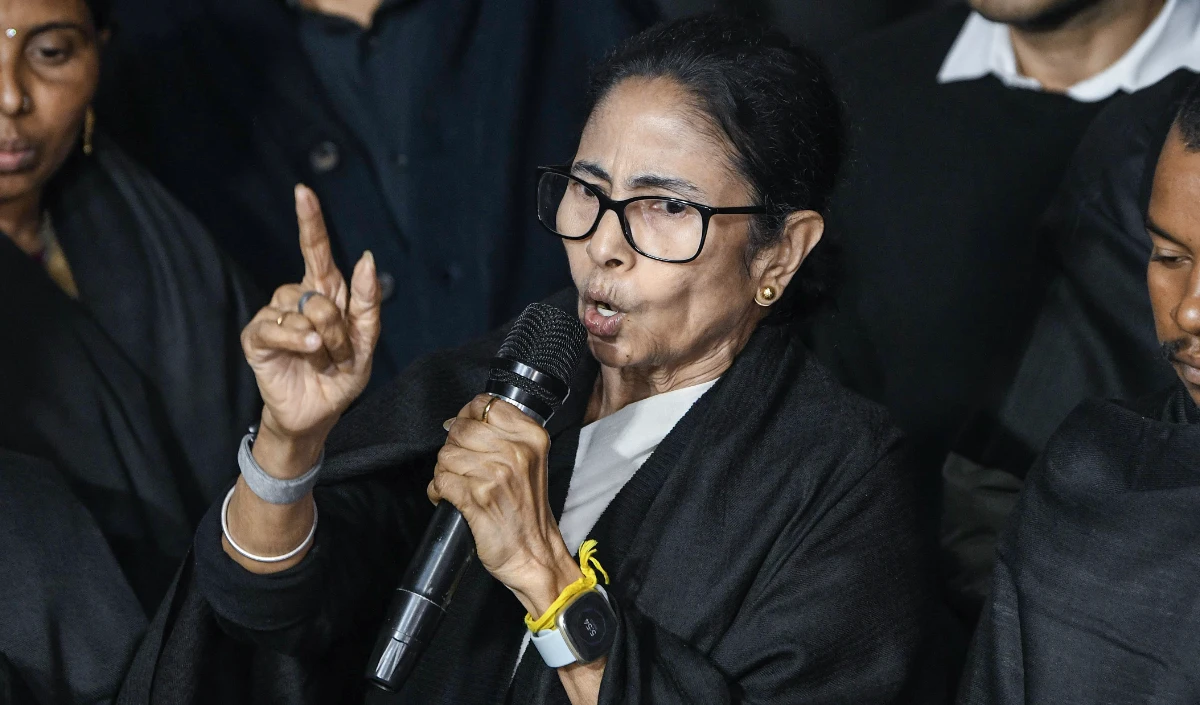

In a historic move on February 4, 2026, West Bengal Chief Minister Mamata Banerjee personally appeared before the Supreme Court to argue against the Election Commission of India’s (ECI) Special Intensive Revision (SIR) of electoral rolls.
The hearing, presided over by a bench led by Chief Justice of India (CJI) Surya Kant, saw the Chief Minister—a trained advocate—take the floor to challenge what she called a “systematic attempt” to disenfranchise voters ahead of the 2026 Assembly elections.
Key Highlights: Mamata Banerjee’s Submissions
Mamata Banerjee argued that the SIR process is being used as a tool for deletion rather than inclusion, alleging that over 1.88 crore names (58 lakh in Phase 1 and 1.30 crore in Phase 2) have been impacted.
1. The “Bulldoze” Allegation
The CM accused the ECI of appointing “micro-observers” from BJP-ruled states to oversee voter deletions in Bengal.
“They have targeted West Bengal… to bulldoze West Bengal people,” she submitted, arguing that these observers were making unilateral decisions to strike off names under the guise of “logical discrepancies.”
2. Why No SIR in Assam?
Banerjee repeatedly questioned the selectivity of the ECI’s drive.
- She asked why the intensive revision was being carried out in opposition-ruled West Bengal and Tamil Nadu, but not in BJP-ruled Assam.
- She claimed the timeline—seeking to do in three months what usually takes two years—was designed to create “panic” and had led to over 150 deaths, including Booth Level Officers (BLOs) who died due to work-related stress.
3. The “WhatsApp Commission”
In a sharp critique, the CM referred to the poll body as the “WhatsApp Commission,” alleging that officials were issuing informal, non-statutory instructions via the messaging app instead of following official legal protocols.
4. “Logical Discrepancies” and Gender Bias
Banerjee highlighted that minor issues like spelling variations or transliteration errors (Bengali to English) were being used to delete voters. She specifically mentioned that women were being targeted if their surnames changed after marriage or if they moved to their in-laws’ house.
Supreme Court’s Observations and Order
The bench, which also included Justices Joymalya Bagchi and Vipul Pancholi, took a balanced view of the high-stakes arguments:
- Notice Issued: The Court issued a formal notice to the Election Commission of India on the CM’s petition.
- Sensitivity to Authors & Icons: Following reports that even notable figures (like Amartya Sen) had faced scrutiny, the CJI cautioned the ECI: “Please send notices carefully. You cannot put out notable authors, etc.”
- Collaborative Solution: The CJI suggested that if the State Government provides a list of its own Group B officers to act as EROs (Election Registration Officers), the controversial “micro-observers” from other states could be relieved.
- Next Hearing: The case is scheduled for its next hearing on Monday, February 9, 2026, when the ECI is expected to file its response.