

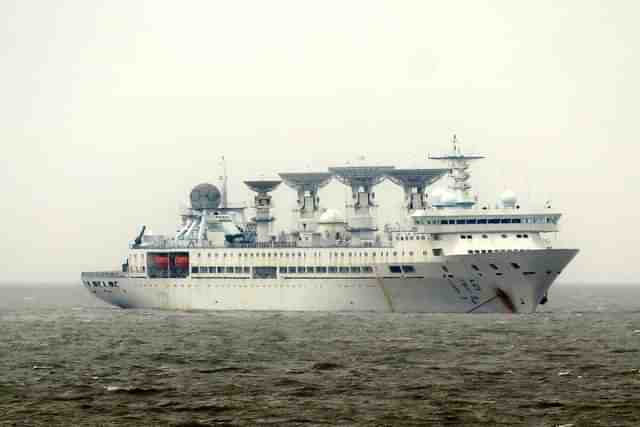

Ship-tracking data has revealed that at least four Chinese vessels are currently active across the Indian Ocean Region (IOR), with one positioned dangerously close to a notified missile test path. This growing presence has prompted India to alter its missile testing schedule in the Bay of Bengal to counter possible surveillance attempts by Chinese “research” ships.
India Changes Missile Test Plans Amid Surveillance Threat
New Delhi:
India has revised and delayed two planned missile tests after detecting multiple Chinese vessels positioned in locations ideal for monitoring test trajectories and collecting sensitive military data.
According to ship-tracking data, one of the Chinese vessels is positioned close to a notified “danger zone” for missile testing. These ships often claim to be research vessels but are known to carry radar, telemetry receivers, and electro-optical tracking systems, capable of capturing detailed information such as trajectory curves, terminal accuracy, and target engagement.
Two NOTAMs Cancelled Within Days
Within the last five days, civil aviation authorities cancelled two Notices to Airmen (NOTAMs) that had temporarily restricted flight movement over large sections of the Bay of Bengal.
These NOTAMs marked two long, narrow quadrilateral zones originating near the Indian Navy base in Visakhapatnam and from Abdul Kalam Island, Odisha—patterns consistent with earlier missile test zones.
Open-source intelligence researcher Damien Symon analysed the reserved areas, estimating lengths of 1,450 km and 3,500 km, suggesting short-to-medium range missile testing.
- The first NOTAM was issued on November 25 for a test scheduled between December 6 and 8 but was cancelled on November 27.
- A replacement NOTAM was issued for December 1–4.
- This too was withdrawn on November 30, coinciding with the approach of the Chinese vessel Lan Hai 101, which was moving from the Malacca Strait toward Sri Lanka.
On Monday, the DGCA issued a new NOTAM, marking a fresh rectangular test zone off the Srikakulam coast in Andhra Pradesh. The designated window indicates a likely naval platform-based missile test on the morning of December 11.
The Ministry of Defence has so far issued no official statement on the cancellations.
Chinese Ships Continue to Shadow India’s Missile Tests
Ship-tracking records from MarineTraffic and NOTAM data analysed by NDTV show that Lan Hai 101, officially labelled as an aquaculture survey vessel, was just 300 km from the southern edge of the new December 11 test zone on Sunday.
This is not the first time that Chinese ships have attempted to position themselves near India’s missile testing routes:
- In 2019, Indian Navy warships chased away suspected Chinese spy ship Shi Yan 1 near Port Blair.
- In 2022, Chinese tracking vessel Yuan Wang-6 was observed in the IOR ahead of a missile test.
- In March 2024, Xiang Yang Hong 01 was spotted lurking in the Bay of Bengal along a scheduled test trajectory.
- In June 2024, French satellite intelligence firm Unseenlabs detected another Chinese research vessel secretly operating in the Bay of Bengal for several days.
The Legal and Strategic Challenge
Under international maritime law, India cannot act unless a foreign vessel engages in overtly hostile activity. Even then, Chinese ships can technically request entry into India’s Exclusive Economic Zone (EEZ) without violating maritime norms.
China’s growing maritime presence in the IOR has increasingly complicated India’s missile testing programme, forcing more frequent adjustments to safeguard classified flight data. As both nations continue to assert influence in regional waters, this cat-and-mouse dynamic is expected to persist.