

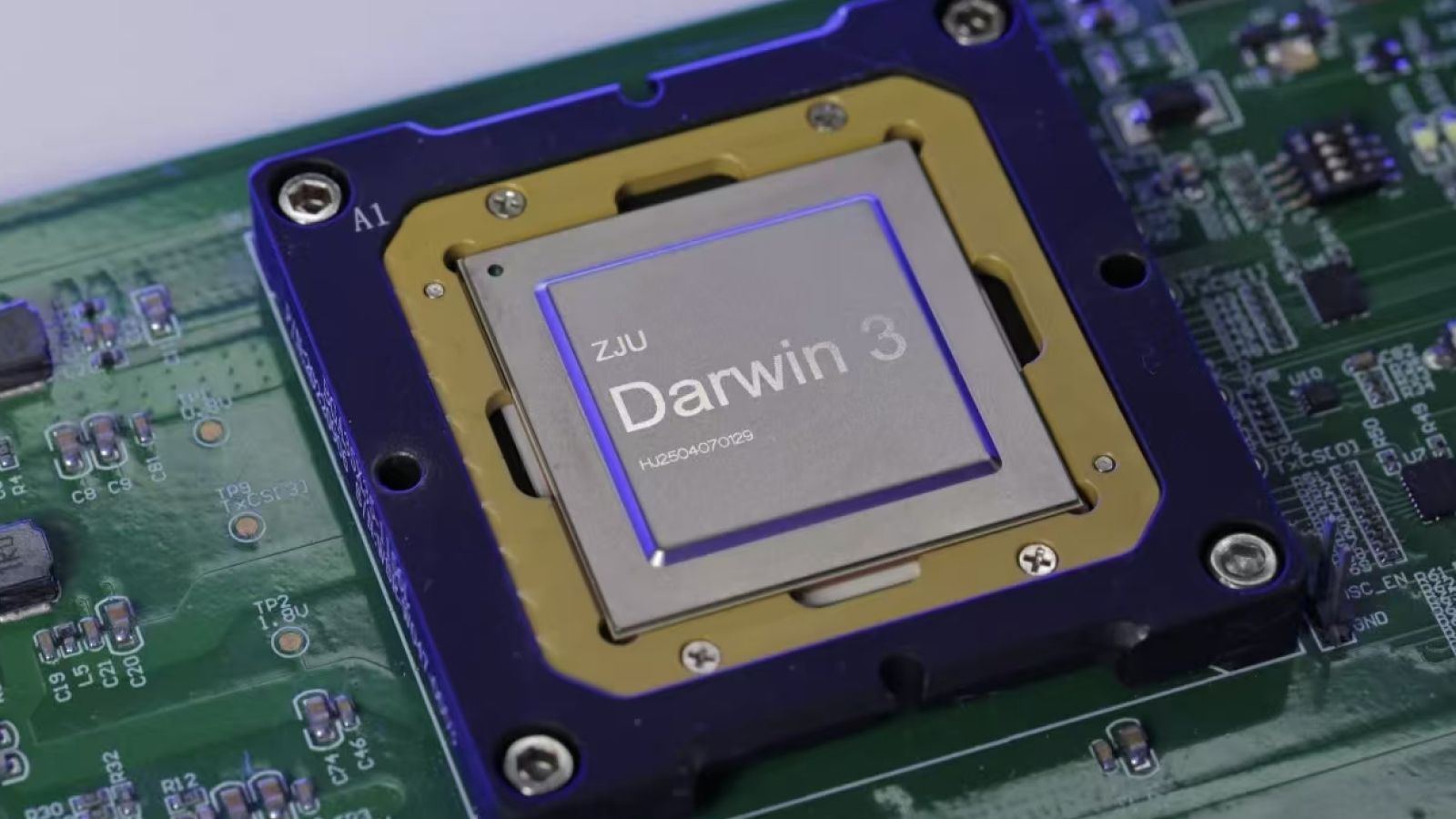

NEW DELHI: Researchers in China have made a big step forward in brain-inspired computing by making the world’s largest neuromorphic computer chip. They call it “Darwin Monkey” or “Wukong.” The supercomputer was made by Zhejiang University and Zhejiang Lab with money from the Alibaba Group. It is based on the neural structure of a macaque brain and is a big step toward creating Artificial General Intelligence (AGI).
The “Darwin Monkey” system has more than 2 billion fake neurons and more than 100 billion synapses. This is greater than the previous record holder, Intel’s Hala Point. The architecture of this system, which is based on spiking neural networks (SNNs), is what makes it unique. SNNs don’t analyze continuous data like regular computers do. Instead, they work like biological neurons by sending out bursts of electrical activity (spikes) only when they get enough information.
This one-of-a-kind parallel processing architecture saves a lot of energy. The people who made the “Darwin Monkey” say it only needs 2,000 watts of electricity, which is a little amount compared to what most supercomputers use. The system runs on 960 Darwin III neuromorphic chips, each of which may accommodate up to 2.35 million spiking neurons.
The idea is based on the success of “Darwin Mouse,” which came out in 2020 and replicated a rodent’s brain. The “Darwin Monkey” is better at doing complicated mental tasks including logical thinking, solving math problems, and making content. Researchers think that being able to simulate the brains of animals like zebrafish and mice will speed up progress in both cognitive science and AI research.
This advancement underscores an evolving domain of computing that presents an alternative to traditional supercomputer architectures. Neuromorphic machines don’t use big processing cores; instead, they literally copy the structure of the brain. The “Darwin Monkey” is a technically inventive and process-improved system that could become an amazing tool for both brain science and the creation of smarter machines in the future. It connects AI and AGI.