

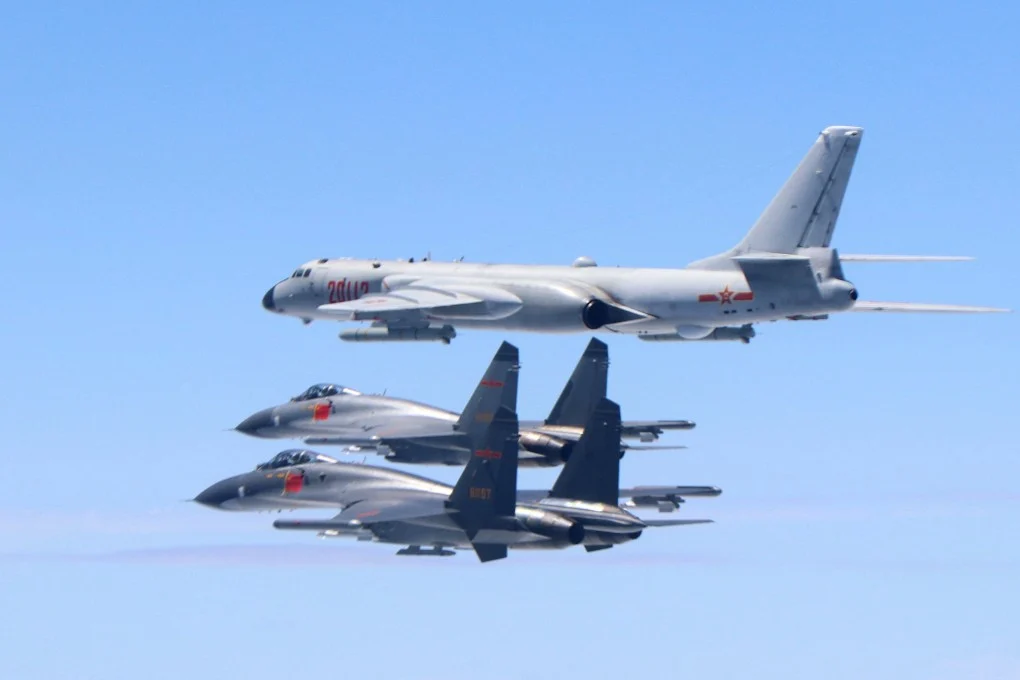

Chinese state media said that a group of its H-6K strategic bombers and J-10 fighter planes had just done “confrontation drills” near Taiwan. China’s Eastern Theatre Command carried out the military action, which was made public only days before U.S. President Donald Trump and Chinese President Xi Jinping are set to meet in South Korea for a regional conference to talk about trade.
The Weibo account for the Chinese state television’s military station said that the combat-oriented training was done to see how well the units could do in important operational areas, such as air blockades and precise strikes.
“The report said that several J-10 fighters flew in combat formation to a specific target airspace, and several H-6K bombers went to the waters and airspace around Taiwan island to carry out simulated confrontation drills.” It did not say when or where the drills took place. The H-6K is a long-range strategic bomber that can carry nuclear missiles.
The broadcast from Chinese state television made Beijing’s political point clear by saying that the drill was about “defending national sovereignty and territorial integrity through ‘concrete actions’ and safeguarding the peace and happiness of hundreds of millions of people is our solemn commitment.” The video that went with the report showed bombs being dropped, and an air force officer was cited as saying that the “coast of Taiwan can be clearly made out,” but this was not corroborated.
Taiwan and the US respond
Beijing thinks Taiwan is part of China, although Taiwan didn’t disclose any strange military activity on its side. Taiwan’s defense ministry’s daily briefing on Monday morning said that in the preceding 24 hours, there had only been a normal presence of four Chinese military aircraft: three fighter planes in the Taiwan Strait and one support aircraft to the southwest of the island. Neither China’s nor Taiwan’s defense ministries gave an immediate response to the drill report.
Marco Rubio, the U.S. Secretary of State, said on Sunday that Taiwan “should not be concerned” about the planned meeting between President Trump and President Xi. The US has strong unofficial connections with Taiwan and is constitutionally required to give the self-ruled island the tools it needs to defend itself, even if its government doesn’t recognize Beijing’s claims of sovereignty.
Peace Must Depend on Strength
A high-ranking Chinese official called for “peaceful reunification” between China and Taiwan on Saturday, the 80th anniversary of the island being handed over from Japanese authority at the close of World War Two. This was the day before the Chinese military began to act tough.
In an interview that aired on Saturday, however, Taiwan President Lai Ching-te disagreed with the sentiment and stressed the necessity for firmness in defense. Lai said that his administration was committed to spending more on defense. He said, “We have ideals about peace, but we can’t be fooled into thinking that an agreement on paper can bring peace.”
Beijing has called President Lai a “separatist” and has turned down his repeated requests to talk. Lai says that only the people of Taiwan should decide what happens to Taiwan in the future.