

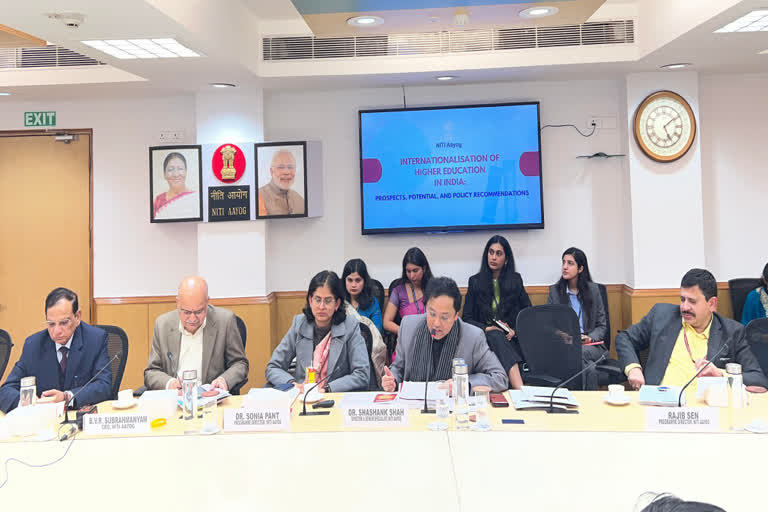

New Delhi: Canada has emerged as the most preferred destination for Indian students seeking higher education overseas, followed by the US and the UK, according to a comprehensive report titled ‘Internationalisation of Higher Education in India’ released by NITI Aayog on Monday.
Global Student Numbers in 2024
The report highlights that India remains the world’s largest source of international students, with over 13.35 lakh individuals studying abroad in 2024. The distribution among the top five destinations is as follows:
| Country | Number of Indian Students (2024) |
| Canada | 4.27 Lakh |
| United States | 3.38 Lakh |
| United Kingdom | 1.85 Lakh |
| Australia | 1.22 Lakh |
| Germany | 43,000 |
The “Brain Drain” Concern
NITI Aayog raised concerns over a lopsided student exchange ratio. The report states that for every one international student who comes to India, 28 Indian students go abroad. This trend represents a massive economic outflow; in the 2023-24 period alone, Indian students spent approximately ₹2.9 lakh crore on education in the top four hosting countries.
Furthermore, outward remittances under the RBI’s Liberalised Remittance Scheme for education have skyrocketed from ₹975 crore in 2014 to ₹29,000 crore in 2024.
Key Source States and Demographics
India possesses the world’s largest population in the 18–23 age bracket, estimated at 15.5 crore. Among Indian states (based on 2020 data), the top contributors to the overseas student population are:
- Andhra Pradesh: 35,614 students
- Punjab: 33,412 students
- Maharashtra: 29,079 students
Inbound Education Trends
Regarding students coming to India (data for 2021-22), Nepal is the leading source country, followed by Afghanistan, the US, Bangladesh, and the UAE. The report emphasizes the need to strengthen India’s “Study in India” initiatives to balance the internationalization of higher education.