

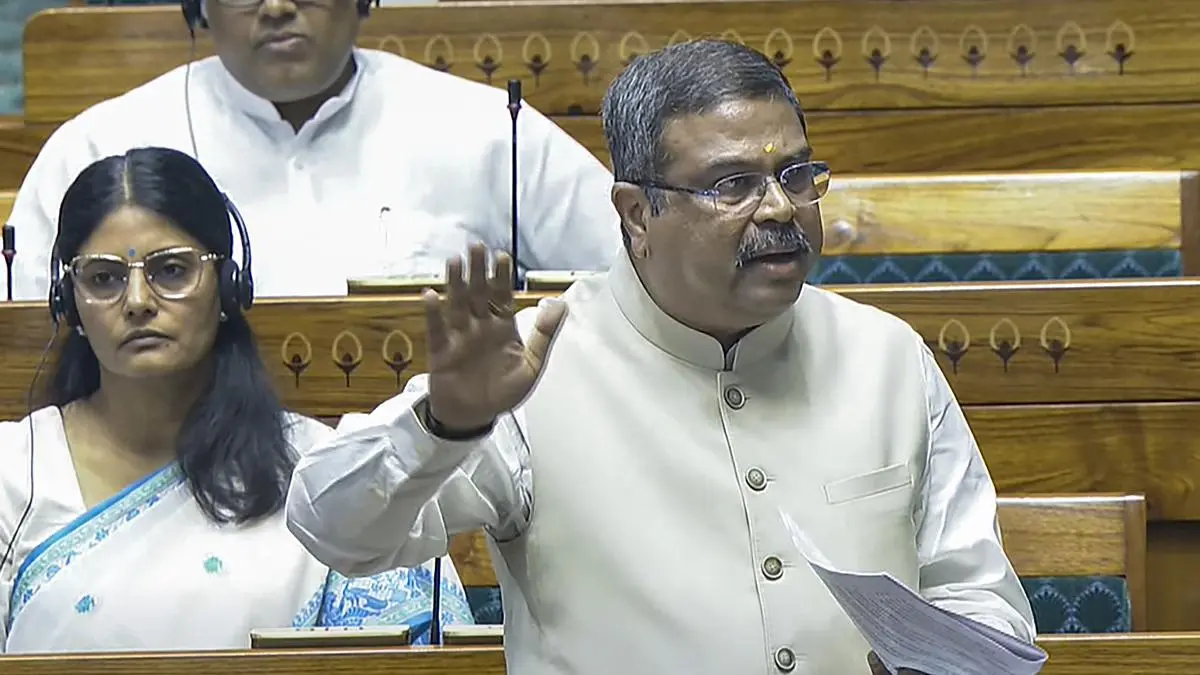

New Delhi [India], March 10 : Bharatiya Janata Party (BJP) leader Praveen Khandelwal on Monday backed Union Education Minister Dharmendra Pradhan after the latter’s remarks in the Lok Sabha, where he criticized the Tamil Nadu government and its stance on the New Education Policy (NEP). Khandelwal clarified that Pradhan had retracted his statement, which was later removed from the proceedings by the Lok Sabha Speaker.
“Union Minister Dharmendra Pradhan has made this clear in Parliament. He has taken back the words he used. The Lok Sabha Speaker has removed it from the proceedings. If a member makes a statement on a topic that has ended in Parliament, then I feel that parliamentary decorum is not being followed,” Khandelwal told ANI.
Pradhan’s initial comments had sparked a major controversy. In his speech in the Lok Sabha, he accused the Dravida Munnetra Kazhagam (DMK) party of being “dishonest” and playing politics at the expense of Tamil Nadu students’ futures. He further criticized the DMK for raising language barriers and engaging in “undemocratic” and “uncivilized” actions.
“They (DMK) are dishonest. They are not committed to the students of Tamil Nadu. They are ruining the future of Tamil Nadu students. Their only job is to raise language barriers. They are doing politics. They are making mischief. They are undemocratic and uncivilized,” Pradhan had said.
The controversy escalated when the DMK staged a walkout in the Rajya Sabha, protesting against the three-language policy and the issue of delimitation. Tamil Nadu Chief Minister and DMK chief MK Stalin strongly criticized Pradhan’s remarks, calling him “arrogant” and accusing him of disrespecting the people of Tamil Nadu. In a post on the social media platform X, Stalin said that the Union Minister’s behavior was that of an “arrogant king” who needed to be disciplined.
This heated exchange stems from the ongoing debate over the National Education Policy (NEP), particularly the controversial three-language policy, which Tamil Nadu vehemently opposes due to concerns over regional language preservation and cultural identity.