

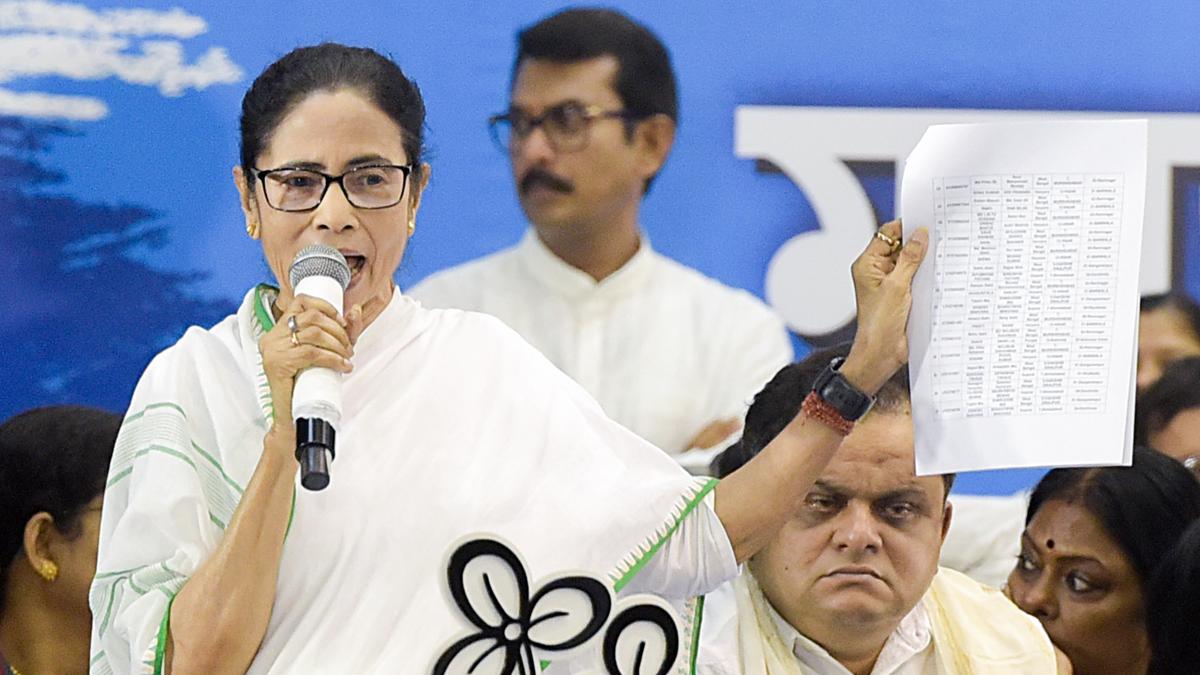

Kolkata: West Bengal Chief Minister Mamata Banerjee will lead a massive rally in Kolkata on Tuesday, protesting what the Trinamool Congress (TMC) calls a “politically motivated revision” of electoral rolls by the Election Commission (EC). The protest comes as the EC begins its Special Intensive Revision (SIR) of voter lists across the state — a process that has rapidly turned into a political battlefield ahead of the 2026 Assembly elections.
SIR Exercise Begins Amid Rising Political Temperatures
The SIR — a routine administrative exercise involving house-to-house verification by booth-level officers (BLOs) from November 4 to December 4 — has become a flashpoint between the ruling TMC and the opposition BJP.
While the BJP has welcomed the revision as a move toward greater transparency in the voter rolls, the TMC has accused the Election Commission of acting under BJP’s influence to manipulate voter data and disenfranchise minorities and marginalised communities.
Political observers see the exercise as the first major test ahead of the 2026 polls, describing it as a “battle between two forces — the administrative and the organisational.”
TMC’s Ground Resistance: ‘Protect Every Genuine Voter’
The TMC, wary of alleged voter deletions, has mobilized its full organisational strength. Party chief Mamata Banerjee and her nephew Abhishek Banerjee, the party’s national general secretary, have launched a statewide campaign to “guard every booth.”
Abhishek Banerjee has ordered the appointment of Booth Level Agents (BLAs) across all 84,000 polling stations to monitor BLOs’ fieldwork and prevent “arbitrary deletions.”
In a virtual meeting with party leaders, he directed that BLOs be “kept under constant watch”, and that TMC agents accompany them during verification. He also announced the creation of war rooms in every assembly constituency, complete with data and coordination teams, describing the next six months as the party’s “acid test.”
Despite this urgency, EC data as of October 30 show the TMC trailing behind its rivals in appointing BLAs — with only 36 BLA-1s and 2,349 BLA-2s deployed. The BJP, by contrast, has appointed 294 BLA-1s and 7,912 BLA-2s, while the CPI(M) has managed 143 and 6,175, respectively. TMC insiders, however, claim the shortfall will be covered soon.
BJP’s Counterclaim: ‘Cleansing the Voter List’
The BJP has accused the ruling party of inflating the voter rolls, claiming that during the 2024 Lok Sabha elections, over 40 lakh duplicate or fake entries existed in Bengal’s electoral list.
“The SIR will finally cleanse Bengal’s voter list. Those who thrived on ghost voters and bogus ballots are panicking,” said BJP state president Samik Bhattacharya.
In response, TMC leaders have issued stern warnings. Barrackpore MP Partha Bhowmik cautioned that if even one “genuine voter’s name” is removed, “local BJP leaders will not be allowed to step out of their homes.”
Abhishek Banerjee went further, threatening to bring “one lakh people from Bengal” to the EC office in Delhi if the party finds evidence of arbitrary deletions.
Tensions on the Ground: Security Concerns and Protests
Amid rising tensions, over 80,000 BLOs have been trained by the Election Commission, which also issued a 16-point guideline and introduced a mobile app to ensure smoother verification. However, the process hasn’t been free of friction.
Several school teachers deputed as BLOs have protested being marked “absent” in school registers during training. Many have demanded central security, citing threats in politically sensitive zones.
“We are being sent to volatile areas without protection,” said a BLO in North 24 Parganas.
The TMC has alleged that four people have died by suicide, fearing they might lose their voting rights, and another is hospitalised after consuming poison. The BJP dismissed these reports as “manufactured melodrama.”
Administrative Timeline and Political Stakes
The EC’s schedule indicates that the draft electoral rolls will be published on December 9, with objections and claims accepted until January 8. The final voter list is set for release on February 7, barely two months before the 2026 Assembly elections likely to be held in April-May.
Analysts say this revision will define Bengal’s political trajectory. “Bengal’s politics has always been fought at the booth level. The SIR will test not just the integrity of the voter list but also the resilience of the two political armies — one administrative, one organisational,” said a Kolkata-based political scientist.
As Bengal’s politics moves from big rallies to door-to-door mobilisation, the voter list itself has become the new battleground — where every name added or removed could sway the state’s political future.