

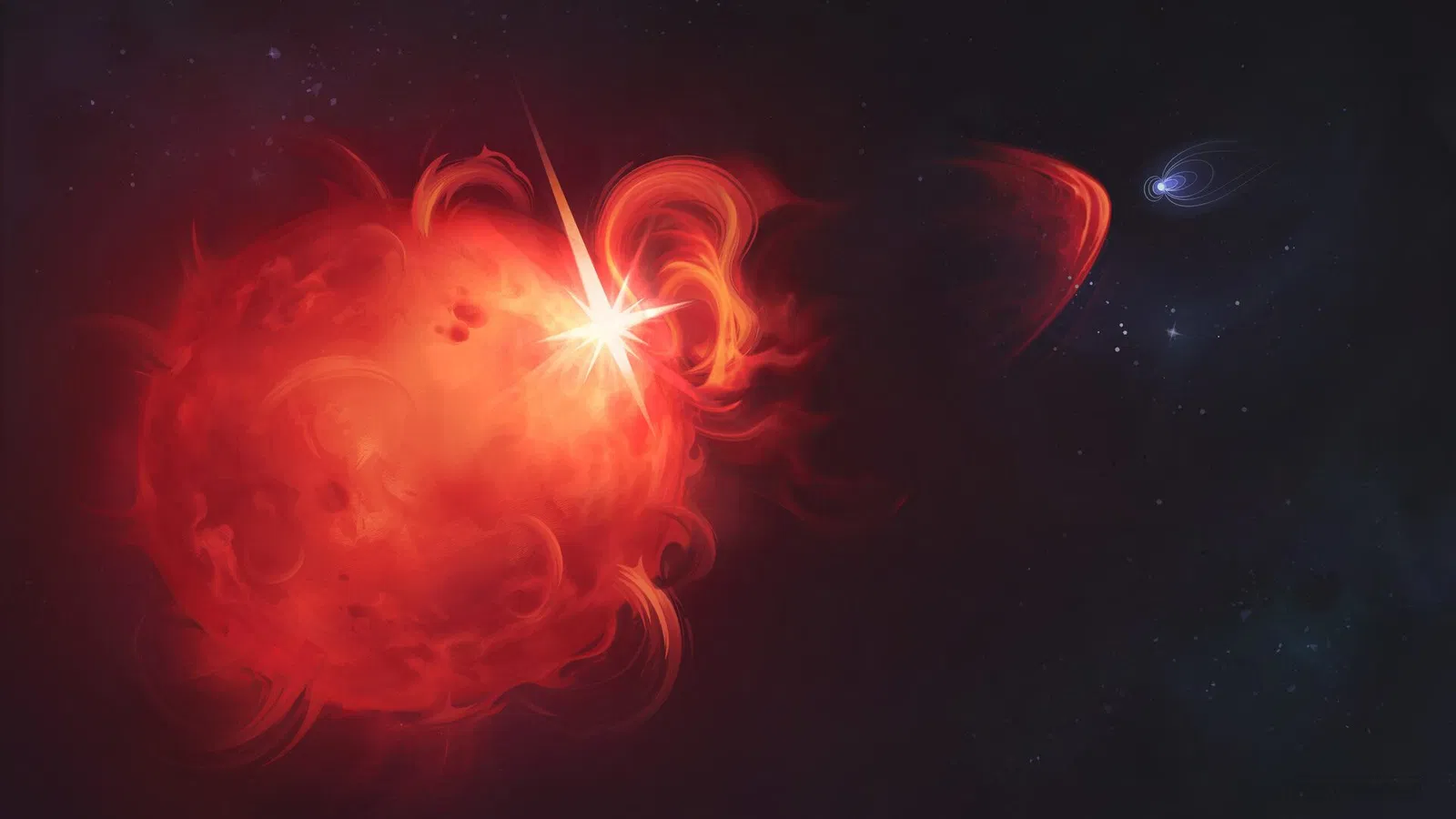

For the first time, astronomers have tracked a massive coronal mass ejection (CME) from a star beyond our Sun, capturing the event as it erupted and then slammed into surrounding material. Using data from XMM-Newton, the European Space Agency’s orbiting X-ray telescope, along with observations from LOFAR, a pan-European low-frequency radio array that includes stations in Sweden, researchers monitored the CME from a red dwarf star located 130 light-years away.
The violent eruption launched superheated plasma at a staggering 2,400 kilometers per second, releasing enough energy to potentially strip the atmosphere from any planet orbiting too close to the star. The discovery adds to mounting evidence that small, active stars — despite being common hosts of exoplanets — may create harsh conditions for sustaining life.
According to Nature, the international team led by Joe Callingham from the Netherlands Institute for Radio Astronomy confirmed the CME by correlating radio wave bursts detected by LOFAR with X-ray emissions recorded by XMM-Newton. Earlier hints suggested that such events might cause the escape of interstellar or circumstellar material, but scientists had remained cautious until now.
“Past observations gave us some clues that local escape of ISM material was possible, but we were still sceptical until we found clear observational evidence for this escape,” Callingham explained.
The red dwarf involved in the study rotates at a rate 20 times faster than the Sun and possesses a magnetic field around 300 times stronger, factors that contribute to the extreme force of its CME. With such powerful magnetic activity, even planets in the star’s habitable zone could face severe atmospheric erosion.
The breakthrough offers crucial insights into space weather beyond our solar system, helping scientists identify which exoplanets may be capable of retaining an atmosphere long enough to support life. It also provides new data on how CMEs influence planetary evolution, atmospheric loss, and long-term habitability.
“This breakthrough opens a new window to study space weather beyond our solar system,” said ESA researcher Henrik Eklund, noting its importance in understanding the threats CMEs pose to exoplanets orbiting active stars.