

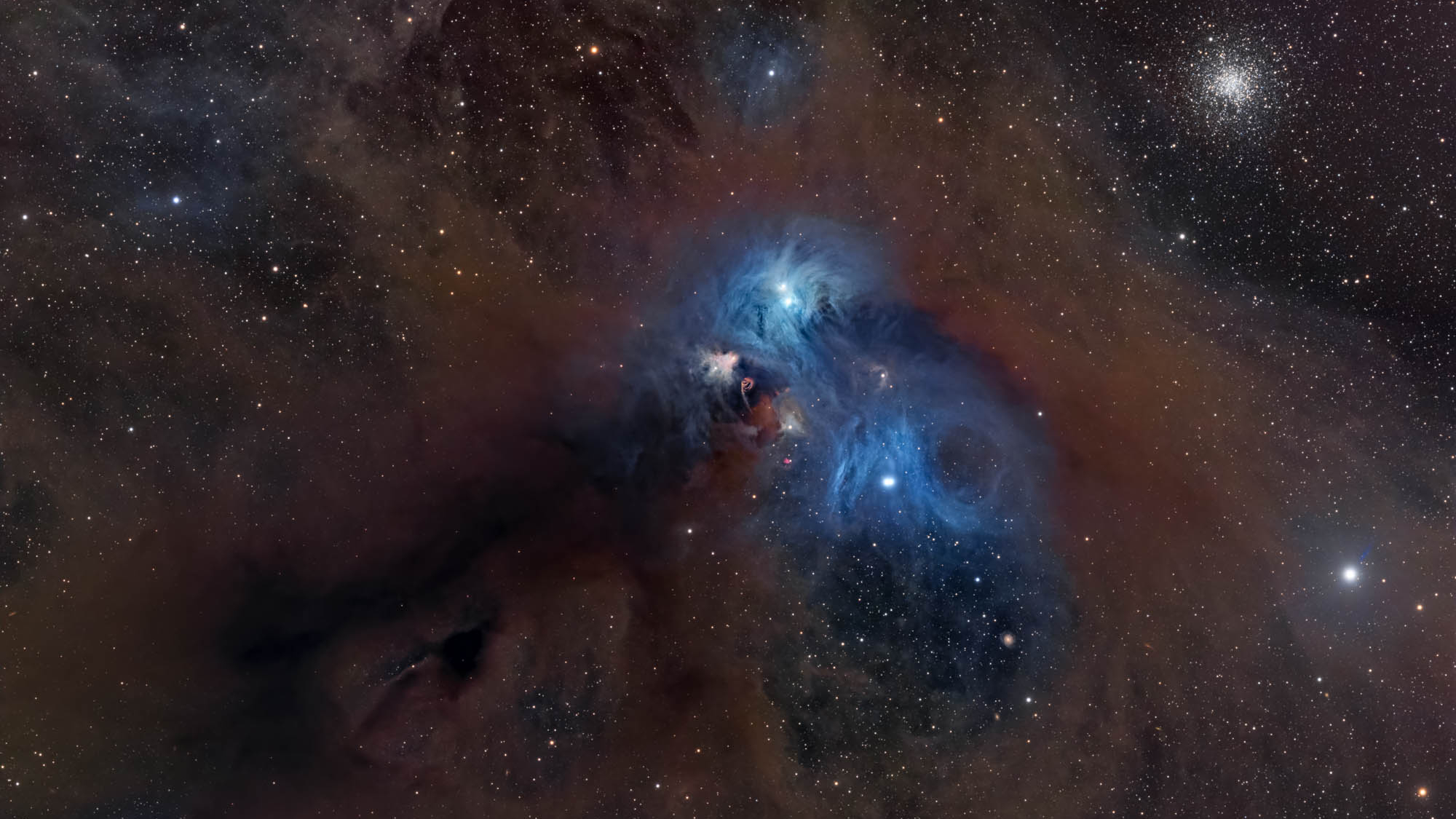

A new picture has shown a beautiful nebula that looks a lot like a baboon’s face, with vivid blue eyes and a dusty brown “mouth.” The Raging Baboon Nebula is a celestial object that is around 500 light-years from Earth and lies in the Corona Australis constellation. People have compared the nebula’s look to the colorful faces of mandrills. The nearby globular cluster NGC 6723 adds to the cosmic splendor.
Taking a picture of the Cosmic Face
Astrophotographer Greg Meyer took the picture at the Starfront Observatory in Texas. Meyer used a 120mm Takahashi Esprit refractor and a QHY 268M camera to take pictures for 13 nights in the summer of 2025, for a total of 16.5 hours of exposure.
The raw photographs were carefully stacked and edited in Photoshop, Lightroom, and PixInsight to show the nebula’s complex structure. The brown molecular dust makes up the “mouth,” and the blue reflection nebulae make the “eyes,” which makes it look like a cosmic baboon is looking into space.
The Science Behind the Form
Starlight and strong winds from stars shape nebulae, which are clouds of gas and dust. The blue reflection nebulae scatter starlight to make the eyes, and the dense absorption clouds make the lips. These sculpted structures are frequent in space, but their designs are often so familiar that they make people think.
The Horsehead Nebula (Barnard 33) and the Skull Nebula (NGC 246) are two well-known nebulae that have also earned their descriptive designations because they look like things on Earth. The Hubble Space Telescope has also shown us space structures like a “jellyfish” proplyd, which was made by star winds.
The Raging Baboon Nebula is a great illustration of how clouds of gas and dust in space can make shapes that look like things we know on Earth. It combines science with a little bit of art from space.