

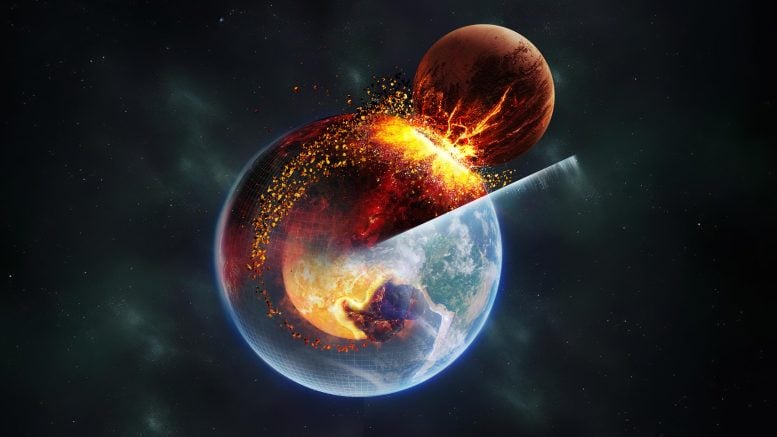

NEW DELHI: NASA scientists have made a stunning new discovery: they have unearthed huge pieces of ancient planetary collisions buried deep in the mantle of Mars. The results, which were made possible by seismic data from the now-retired InSight lander, give us a never-before-seen peek at the Red Planet’s rough early history.
Eight strong marsquakes provided the data for the study, which was just published in the journal Science. Researchers were able to trace the structure of the planet with amazing clarity by studying how seismic waves from these quakes moved through the planet’s innards. This procedure showed that there were enormous, rocky pieces, some as big as 2.5 miles across, all throughout the mantle. These strange shapes look like scars from a time when the planet was hit by huge objects that released enough energy to melt big parts of it. This happened more than four billion years ago.
This revelation is very important because Mars doesn’t have plate tectonics like Earth does. This continual recycling of crust and mantle material on Earth hides signs of old collisions. Mars, on the other hand, has a “stagnant lid” that sealed off its inside early in its existence, making it a one-of-a-kind time capsule of how the solar system formed.
The primary author of the paper, Constantinos Charalambous of Imperial College London, said, “We’ve never seen the inside of a planet in such fine detail and clarity before.” “What we’re seeing is a mantle with old pieces all over it. The fact that they are still alive now shows that Mars’ mantle has changed very slowly over billions of years. These kinds of things may have mostly disappeared on Earth.
The InSight mission, which ran from 2018 to 2022, documented more than 1,300 marsquakes. The crew found that seismic waves were slower to move into the Martian interior, which showed that the density and composition had changed. This helped them find the buried debris.
Tom Pike, one of the paper’s co-authors from Imperial College London, said, “We knew Mars was a time capsule that held records of its early formation, but we didn’t expect to be able to see so clearly with InSight.” He compared the way the parts were spread out like broken glass, with a few big shards and a lot of small ones. This was consistent with a catastrophic collision that destroyed the planet’s internal strength. The results have significant consequences for comprehending the genesis and evolution of other rocky planets such as Venus and Mercury, which similarly lack plate tectonics.